What Is an ECN Broker?
An ECN broker is an intermediary that uses Electronic Communication Networks (ECNs) to give its clients access to market liquidity and let them trade directly with other major market participants, including large banks, big market makers, liquidity providers and brokers.
If this topic interests you, also see “Broker Turkey 2026” and “Broker United Arab Emirates 2026”.
How Does an ECN Broker Work?
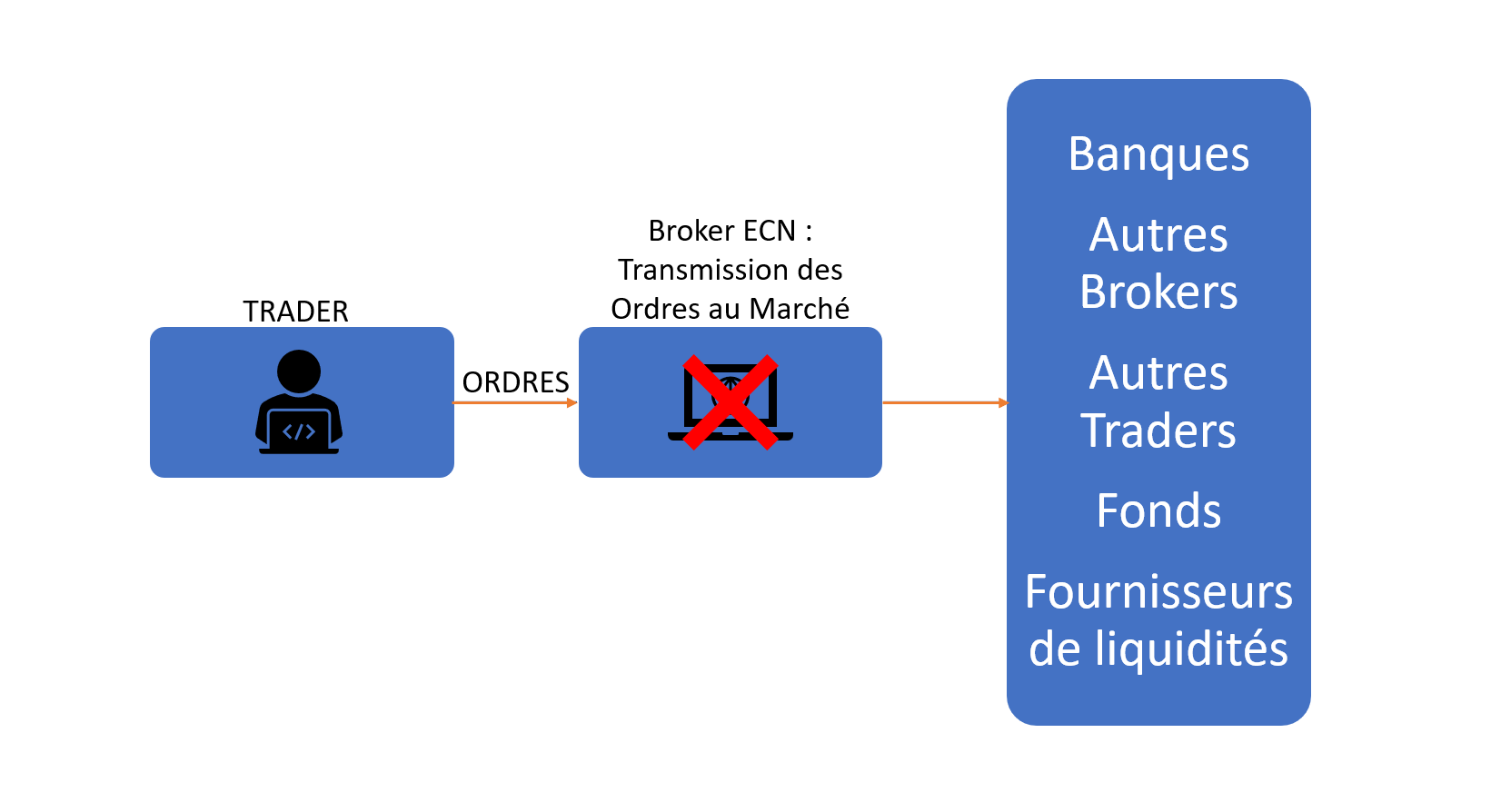
If you’re wondering how an ECN broker works, the answer is that it mainly comes down to passing traders’ orders on to the markets.
An ECN broker’s role as an intermediary (between traders and markets) is limited to routing traders’ orders to the financial markets; the broker does not take part in executing the transaction (the market does that), and it is never the counterparty to the orders of the traders who trade through it.
All such a broker does is aggregate, match or cross the orders of different market participants (independent traders, banks and other financial institutions, etc.) through the ECN system, so that these orders are executed by matching (the orders are passed to liquidity providers).
The diagram below gives a more concrete summary of how an ECN broker, or trading with an ECN broker, works.
What Are the Characteristics of an ECN Broker?
The definition of an ECN broker above and the way it works already give an idea of this type of intermediary’s characteristics. But there’s more to it. Here are the main characteristics of an ECN broker:
- Mechanism
An ECN broker is not the counterparty to the trader’s trades and doesn’t even care whether the trader makes a profit or a loss. It simply passes orders to the markets and matches them (for different participants).
- Execution
Execution is generally excellent (fast). But it can sometimes be slow or delayed, especially when a trade doesn’t match those of other traders and there is no market maker able to accept/execute it (i.e. when market liquidity is low).
- Information
With an ECN broker or a broker’s ECN account, you have access to market information, specifically the order book. You can see in real time the quantity, direction (buy or sell) and prices of orders placed in the market.
- Spreads
Like RaiseFX, ECN brokers generally charge interbank spreads of 0 pips or from 0 pips. This is one of the most attractive features of this type of broker. Depending on market conditions, especially the relative changes in supply and demand, an ECN broker’s spreads can even be negative.
- Minimum volume
An ECN forex broker generally requires a minimum trading volume of 1 mini lot (0.1 standard lot), and it is rare to find ECN forex trading sites that let you trade 1 micro lot (0.01 standard lot). A market maker therefore lets you trade smaller forex lots than an ECN.
- Maximum volume
As they don’t have a trading or dealing desk under their control, ECN trading sites accept higher forex trading volumes than market makers, which often cap trading volumes at a maximum of 5 standard lots.
- Volume requirements for non-forex instruments
For instruments other than forex, ECN brokers generally require medium to high volumes, and sometimes offer a narrower range of assets. They are therefore perfect for forex trading, or for trading other assets with large volumes or position sizes.
- Minimum deposit
Overall, ECN brokers require a higher minimum deposit (usually from $100 / €100) than market maker brokers, which is also why they generally let you trade from 1 mini lot rather than 1 micro lot (the mini lot requiring more capital).
Why ECN Forex: Supply and Demand
A market always involves supply meeting demand, and an ECN broker facilitates exactly that. It matches the orders placed by its clients, and when matching between clients’ orders isn’t possible, it turns to liquidity providers.
These liquidity providers are banks and other financial institutions that supply market liquidity and charge interbank-level spreads. These spreads still vary with market trends and economic news.
Either way, trading forex through an ECN CFD broker gives you a view of market liquidity at the time you trade, and even before placing an order. You can see the current level of supply and demand for the instrument you want to trade.
Example: to see the supply and demand for EUR/USD when trading forex with the ECN broker Vantage, for example, simply (from your MetaTrader account):
- Right-click on the EUR/USD pair in the instruments/symbols section
- Select “Depth of Market”
You’ll then have access to the EUR/USD order book at that moment and can see the quantity bid, the quantity offered and the related prices.
ECN Forex on MetaTrader
The MetaTrader suite of trading platforms is the most popular with retail and independent traders and is widely used for forex trading. For instance, more than 70% of forex brokers offer the MetaTrader 4 forex trading platform. Even more striking, around 90% of forex traders use MetaTrader 4.
How can MT4’s huge popularity for forex trading be explained? In short, it comes down to the platform’s main advantages:
- Intuitive and easy to use (although beginners will need a little time to get used to the features);
- Small file size on PC and mobile;
- Many customisable charts;
- Ability to open/close positions (place orders) from the technical analysis screens;
- Numerous indicators;
- Automated trading options;
- Finally, the ability to trade using ECN technology on MetaTrader.
On this last point, since its launch in 2005, MT4 had not always truly integrated ECN technology. It was only from 2009, with the addition of ECN Bridge technology to the platform, that MetaTrader 4 (and later MetaTrader 5 after its launch in 2010) could be used to access the interbank forex market, and therefore to trade forex via ECN.
So it is possible to trade ECN forex via MT4. In fact, the best ECN forex brokers offer MetaTrader 4 to their clients. This is the case with MetaTrader 4 ECN forex brokers such as Vantage.
MetaTrader 5 is also widely used for ECN forex trading. It is the trading platform that succeeded MetaTrader 4 in 2010, but it has not replaced MT4 and is less popular (which doesn’t mean it performs worse).
MT5 integrates ECN trading very well and gives access to liquidity providers such as FastMatch, Integral FX Grid and LMAX Exchange. The broker Vantage offers ECN forex trading on MetaTrader 5, among the other best MetaTrader 5 ECN forex brokers.
Trading Forex With an ECN CFD Broker
- An ECN CFD broker lets you trade CFDs (contracts for difference) with ECN-style execution. With such a broker, you can trade both up and down on the price differences of certain assets between the time you open your position and the time you close it.
- You can use CFDs for hedging (particularly through short selling) and even use high leverage to trade these instruments.
- Forex trading as we know it today is actually made possible by CFD-type contracts. As with other instruments available as CFDs (stocks, commodities, indices, etc.), you don’t own the underlying assets (the currencies or currency pairs) when you trade forex.
- You are actually speculating on the price difference between the time you open your position on a currency pair (entering the forex CFD contract) and the time you close it (closing the forex CFD contract). An ECN-type CFD broker is probably the best choice for trading this type of instrument, especially for certain types of traders (as we’ll see in the section “Who Is an ECN Broker For?”). In the next section, we present the best ECN trading sites for forex, CFDs in general and many other instrument categories.
What Are the Best ECN Brokers in 2026?
Here is a carefully chosen selection of the best ECN brokers right now. They may be pure ECN brokers or brokers offering ECN accounts alongside STP or standard (market making) accounts.
Vantage – MetaTrader 4 & 5 ECN Broker
Vantage is both an STP and an ECN broker, and in both cases it has no dealing desk, does not trade against its clients and cannot have a conflict of interest with them.
 ★★★★★ 5/5 | Regulated by: FCA, ASIC, CIMA Year founded : | Headquarters : Sydney, Australia
| Test the Broker |
For its ECN brokerage business, Vantage offers two accounts: RAW ECN and PRO ECN. You can open a RAW ECN account through Vantage’s normal sign-up process. However, a PRO ECN account can only be opened by contacting the broker’s customer service, after first funding your account with at least $20,000.
With both Vantage ECN accounts, you can trade on the popular MetaTrader 4 and MetaTrader 5 platforms. Both accounts offer excellent trading conditions, including:
- A rich selection of assets;
- Ultra-fast order execution;
- Exceptional liquidity;
- Competitive commissions.
Already quite competitive with the RAW ECN account, Vantage’s commissions are even better when you move to the PRO ECN account. Here is an overview of the commissions for each account type.
Axi – MetaTrader 4 NexGen ECN Broker
Axi (formerly AxiTrader) is a broker offering the MT4 platform along with the NexGen add-on that can be built into it. This add-on is popular for the many useful features it adds to MetaTrader: stealth orders, forex correlation matrices and more.
 ★★★★☆ 4.5/5 | Regulated by : ASIC, FCA Year founded : | Headquarters: Sydney, Australia Minimum Deposit : | Test the Broker |
Axi’s ECN account is called the Pro Account. Unlike the ECN accounts offered by many brokers, Axi’s Pro Account has no minimum deposit. It also comes with competitive commissions, as you can see in the following table.
Types of ECN Trading Sites
Although many brokers may present themselves as ECN brokers, the way they implement ECN technology isn’t always the same. In practice, there are 3 categories or types of ECN trading sites:
True ECN Brokers
A true ECN broker really works as described at the beginning of this guide. Its clients place orders on a transparent platform (most often MetaTrader); it passes them on to the markets and matches them, while drawing on liquidity from large banks and other financial institutions.
Joint ECN Brokers
This is a combination of two brokers acting as intermediaries between their clients and the markets. Clients usually place orders through an ECN trading platform developed in-house by the broker, which can often lead the broker to manipulate its clients’ orders.
So-Called ECN Brokers
These are the ECN brokers to avoid at all costs. They call themselves ECN brokers with accounts dedicated to ECN trading, but they don’t work like ECN brokers. They may trade against their clients (which goes against how ECN trading works), charge high spreads and even disappear with traders’ money.
ECN Broker vs Market Maker vs STP
The table below gives an overview of the main characteristics of each type of broker and the differences between them (ECN brokers vs STP brokers vs market maker brokers).
ECN | STP | Market Maker |
Orders passed to liquidity providers and other market participants (traders, brokers, etc.) | Orders passed to liquidity providers | Orders executed by the broker at its discretion |
Spreads from 0 pips + commissions | Fixed or variable spreads | Fixed spreads |
Prices from matching market participants’ orders and from liquidity providers | Prices from liquidity providers | Discretionary prices |
Automatic execution, no requotes | Automatic execution, no requotes | Execution from the dealing desk by taking the opposite side of the trader’s orders, or by passing orders to a market maker + possible requotes |
Market depth visible | Market depth not visible | Market depth not visible |
Minimum deposit usually high | Minimum deposit usually low | Minimum deposit usually low or zero |
What Brokerage Fees Do ECN Brokers Charge in [userip_location type=”country”]?
ECN brokers charge 4 types of fees, 3 of which are true brokerage fees.
ECN Broker Spreads
The spreads charged by ECN brokers are at interbank level, which is why they are generally very low or even zero. In concrete terms, this is the real spread of the currency market. When a market maker broker gets this spread, it then applies a markup (increase/widening) before offering a new (higher) spread to traders. If the interbank spread is 0.2 pips, for example, the market maker adds a 0.3-pip markup (as its margin or profit) and offers clients a 0.5-pip spread.
An ECN broker doesn’t need to add this markup, because it earns its money from commissions. It therefore only charges you the interbank spread; this is often called “raw spreads” (meaning the interbank spread is not modified), which is probably why some brokers use the word “Raw” in the names of their ECN accounts.
ECN Broker Commissions
Commissions are the main brokerage fees charged by ECN brokers and their main source of income. These commissions are generally fixed and expressed as a nominal amount ($2, for example) or a percentage (0.02%) per volume of instrument traded.
ECN broker commissions are very often quoted per side. This means you are charged each time you make a transaction: once when you buy or open the position, and again when you sell or close it. For example, a commission of $2 per side means $2 on the buy + $2 on the sell = $4 in total. Other ECN brokers quote it directly for both sides combined (known as “round turn”), i.e. $4 in the example above.
Here is a comparison of the commissions charged by the best ECN brokers right now.
Broker | ECN Account | Commissions |
 |
|
|
 |
|
|
 | Pro | $3.5 per lot per trade |
ECN Broker Swaps
ECN brokers also charge swap fees or overnight fees on positions held open overnight (or for several nights). This is entirely in line with how the market works. However, Muslim traders can avoid paying (or receiving) swaps by trading with an Islamic account.
 Diversifiez votre patrimoineInvestissez dans l’artDes tableaux originaux, pièces uniques signées par l’artiste. Un actif tangible, loin des écrans et des cotations.Voir les tableaux →
Other ECN Broker Fees
Other fees may or may not apply depending on the ECN broker you use. These include deposit, withdrawal, management and inactivity fees, etc. Of course, these other trading costs with ECN brokers are not brokerage fees as such.
Who Is an ECN Broker For in 2025?
In the past, only institutional investors could use an ECN broker, given the specific nature of its intermediary service. Today, even retail and independent traders can use an ECN broker’s services.
However, this type of broker is ideally suited to one main category of independent traders: active traders.
As they generally make many trades in a short period (most often within a single day) with large volumes or position sizes, active traders would spend a lot of money on brokerage fees if they had to trade with a market maker broker.
With an ECN broker, on the other hand, spreads start at 0.0 pips and can even be negative, and commissions are generally fixed. In this case, whatever is happening in the markets, the trader knows, for example, that they will always pay commissions of €1.5 for a trade of 1 standard forex lot with the PRO ECN account of the ECN broker Vantage.
That would not be the case with a market maker broker, whose brokerage fees, expressed as spreads, vary by currency and sometimes even with market conditions, and this variation generally makes the ECN broker’s fees far more advantageous for the trader.
The active traders for whom an ECN broker is ideal are therefore:
- Scalpers
- Day traders
ECN Broker for Scalping
Scalping is probably the fastest trading strategy, as the time an asset is held (after buying and before selling it) is extremely short (from a few seconds to a few minutes). The aim is to profit from tiny price movements, which may be as small as the spread.
As a result, to make significant gains, you need to open and close large or even very large positions, which would cost the trader a lot in spreads.
With an ECN broker, however, spreads are either equal to 0.0 pips (zero, and even possibly negative) or from 0.0 pips, always remaining very low in the latter case. Commissions are charged instead, and they are generally fixed. Even when they are expressed as a percentage of the position size, as with some ECN brokers, they remain far more advantageous than spreads.
ECN Broker for Day Trading
A day trader is an active trader who opens and closes positions with a holding period longer than a scalper’s, but still less than 1 day (positions are closed on the same day they were opened). None of their positions stays open overnight.
As with scalpers, the aim of a day trader or intraday trader is also to profit from small market moves. They therefore need to make several large trades in a day, which is expensive when brokerage fees are charged only as spreads. The same day trader, however, will save a lot by trading with an ECN broker.
Example. If you want to trade 1 standard lot of EUR/USD, you will pay an average spread of 1 pip with a market maker. That equals brokerage fees of 1 (1 standard lot) x 10 USD (value of 1 pip for 1 standard lot) x 1 (spread for EUR/USD) = $10 (the spread is expressed in the quote currency, here USD).
If, however, you trade the same EUR/USD pair with Vantage using the PRO ECN account, you pay a commission of just €1.5 per side, i.e. €3 in total for both sides (opening and closing the position). A small spread may be added to this amount.
These fee advantages also apply to news traders, position traders and algorithmic traders, as these are also often used as active trading strategies.
In addition to competitive brokerage fees for active traders, an ECN broker gives them more information/transparency (you access market liquidity directly and see pending orders) and more convenience (it’s easier to calculate your fees when they are fixed for each position size, and even to estimate your likely gains/losses).
Pros and Cons of ECN Brokers
The following table briefly presents the main advantages and disadvantages of ECN brokers.
Pros | Cons |
|
|
How to Choose an ECN Broker in 2025
Here are the main criteria to consider when choosing the right ECN broker:
- Regulation – The first proof of reliability, regulation is crucial for an ECN broker, as for any other type of broker.
- ECN network – You need to find accurate, up-to-date information on the broker’s connection to an ECN network and how it works.
- Liquidity providers – They are essential for market liquidity. Your chosen ECN broker should list the liquidity providers it works with, and it’s better if they are numerous or large, and ideally both.
ECN Trading Conditions
Check the trading conditions the broker offers and make sure they are worthy of an ECN broker and competitive. These include execution (fast and without requotes), spreads (zero, variable and very low, at interbank level), commissions and so on. You can use an ECN demo account to test these trading conditions, but ideally you should open a live ECN account.
Besides these main criteria, you should consider the usual criteria for choosing a broker, including:
- How user-friendly the trading platform is
- Useful, intuitive trading and research tools
- The quantity and quality of educational content
- The range of instruments offered
- The leverage available
- The quality of customer service, etc.
How to Spot a Fake ECN Broker
Some brokers that claim to be ECN (or claim to offer ECN accounts) are not always what they say. Here are a few details that can help you detect fake ECN brokers.
Fixed spreads
An ECN broker offers its clients interbank spreads, which are by nature variable. A true ECN broker offers very low or even zero spreads, but they are always variable. That’s why the details of an ECN account usually say “spreads from 0 pips” rather than “0-pip spreads”.
No liquidity providers
If a broker gives no information about its liquidity providers or has none, it probably runs a dealing desk and is only a pseudo-ECN broker. Also be wary of ECN brokers whose main or one of whose liquidity providers is a parent financial institution or belongs to the same group or company as the broker. In that case, your trades may be controlled or even manipulated.
Limits on positions and gains
A true ECN broker simply connects you with the market. It doesn’t manipulate your trades, isn’t interested in what you might win or lose, and therefore doesn’t limit (by capping) your position sizes or potential gains. It lets you take on the market and make the most of it.
Scalping and other active trading strategies not allowed
A broker that prevents you from trading actively wants to control your transactions and profit from them, which should not be the case with a good ECN broker. A true ECN broker simply lets you interact with other market participants, whatever your trading strategy. You can trade actively, and even automatically, without bothering a true ECN broker, which relies solely on its commissions for income.
Only negative slippage
Slippage occurs normally in financial markets, even with an ECN broker. As a reminder, slippage happens when the price shown for your order is slightly different from the price at which it is executed. Slippage can be negative, but also positive. If you only ever get negative or unfavourable slippage with a broker or account claiming to be ECN, it’s a fake ECN. It is controlling your trades and keeping the value of your favourable slippage for itself.
No access to market liquidity or depth
One of the main features of an ECN broker is that it lets you see market liquidity: the quantity and price of available orders and much more information. If this isn’t possible with a so-called ECN broker/account, it’s a fake ECN account/broker.
Just getting started or already trading with an ECN broker? Feel free to share your experience with us by leaving a comment below!