What Is a Broker? Definition
What is a broker? In French, a broker is sometimes called a “courtier”, sometimes a “représentant” and occasionally a “cambiste”. Whatever the synonym or name used, a broker is simply someone who acts as an intermediary in a transaction.
Found in insurance, real estate, commodities or vehicle sales, the broker is the go-between in a negotiation. Whether an individual or a legal entity — a person or a company — a broker is first and foremost a trader in the commercial sense.
An English term used in finance, where it means “courtier”, and in computing, where it translates as “intermediary” or “relay” (which is what a broker means in IT), the word broker comes from the Anglo-Norman “brocour”, meaning a “small trader”.
In Old French, words such as “broqueter” or “broqueteur”, used for a “wine merchant”, are also cited as etymological roots of the word “broker”. These clarifications (definition, synonyms, etymology) help explain what a broker is.
If this topic interests you, also read “Commission-Free Broker” and “Dukascopy vs Swissquote”.
A Brief History of Brokers
The beginnings of the brokerage profession appeared in Julius Caesar’s Rome. However, the exchange did not survive the fall of the Empire 600 years later. It was not until the Italian Renaissance that trading in government bonds re-emerged in cities such as Florence, Venice and Genoa. In Northern Europe, during the same period, some were already trading shares in mines and ships.
Before 1985, the only way for investors to place orders was by telephone, and buying or selling shares was not very easy. 1985 saw William Porter create the first online trading platform (the first online broker in history).
This was followed in 1991 by E-Trade Securities Inc. Since then, many online trading platforms have emerged, improving as technology advances.
Types of Brokers
There are many types of brokers, which can be grouped according to the instruments or markets they operate in, the regulations that authorise their operations, the countries where they operate, or their order execution types. Here are the different types of brokers based on these criteria.
Brokers by Instrument / Market
Here is an overview of the different types of brokers by market or instrument traded.
- Forex Broker
A Forex broker works with individuals and professionals, offering them the chance to invest in the foreign exchange market (Forex). Access to the currency market, normally open only to institutions, is only possible for individuals through a Forex broker.
Active every day and at all hours on various currency markets, its job is to buy and sell currencies on the client’s behalf. It is the intermediary between the trader and the Forex market. That is what a Forex broker is.
Today, the internet makes it easy to find online Forex brokers. What generally sets them apart, however, is their costs, which are mostly very competitive, and some brokers are recognised as the Forex brokers with the lowest fees.
- Stock Broker
A stock broker is similar to a Forex broker, the only difference being that it only offers trading solutions on shares of various listed companies. Without its intermediation, neither retail investors nor retail traders can access the stock market.
- Futures Broker
High-risk speculative products, futures are financial instruments that let you anticipate future movements in a stock index, a share or any other underlying asset. To invest in futures, you need to go through a futures broker. So what is a futures broker? It is simply the broker whose role is to route traders’ orders to the futures market.
- Options Broker
An options contract allows a buyer to buy or sell an underlying asset at a set price. The underlying asset is the product on which the contract is based (share, ETF, index, etc.). An options broker is therefore a broker that lets you invest in the options market.
- Commodities Broker
A commodities broker lets you trade commodities on the spot market or through derivatives (futures, options, etc.). These commodities include agricultural products (livestock, wheat, etc.), energy (petrol, oil, etc.) and metals (aluminium, gold, silver, etc.). Gold, for example, is often used as a safe haven and can be traded in US dollars (XAU/USD), euros (XAU/EUR) or yuan (XAU/CNY).
- CFD Broker
Many trading beginners may wonder “what is a CFD broker?”, which is understandable given that almost all online trading brokers are CFD brokers. A CFD broker lets you trade or invest in CFDs.
A CFD is a Contract for Difference. In practice, it is a type of derivative or contract that lets you speculate on the difference between an asset’s opening and closing price without owning the underlying asset.
A CFD broker therefore lets you speculate on the price movements of an asset (stocks, currencies, commodities, indices, etc.), usually with leverage.
- ETF Broker
What is an ETF broker? It is a broker that lets you trade exchange-traded funds (ETFs, mutual funds, etc.). Investing in these funds is ideal for any stock market investor who wants to diversify their portfolio without having enough money to buy various assets individually.
Since an ETF holds a wide variety of assets, investing in ETF units means investing in a fraction of all these assets at once.
Cryptocurrency Broker
A cryptocurrency broker is used to trade or invest in cryptocurrencies (Bitcoin and all altcoins). You can either trade cryptocurrencies as CFDs or invest in physical/spot cryptocurrencies (i.e. buy and actually own them).
Stockbroker
Whether an individual or a brokerage firm, a stockbroker acts as an intermediary between lenders and borrowers. Among other tasks, it must collect stock market orders and ensure they are transmitted to the financial markets/exchanges. It must also manage its clients’ accounts, handle clearing, etc., in exchange for commissions.
Insurance Broker
With in-depth knowledge of the insurance market, an insurance broker’s main role is to advise clients on the insurance policies they want to buy. It must find the cover its clients need from insurance companies.
Full-Service Broker
What is a full-service broker? It is essentially a financial advisor. The range of services a full-service broker offers is very broad: investment and even retirement planning, asset management, banking or lending services, tax optimisation advice, etc.
Discount Broker
As its name suggests, a discount broker charges the lowest commissions. Discount brokers are particularly popular with day traders and, more broadly, with active traders and investors. As well as offering clients a range of analysis and research tools, discount brokers give them direct access to various financial markets through their online trading platforms.
Online Broker
An online broker is simply a broker operating online, on the internet. It is also called a direct-access broker. Online brokers are particularly popular with day traders. The main advantages of these brokerage firms are their direct-access platforms and, above all, their fast order execution.
 Diversifiez votre patrimoineInvestissez dans l’artDes tableaux originaux, pièces uniques signées par l’artiste. Un actif tangible, loin des écrans et des cotations.Voir les tableaux →
Brokers by Regulation
In this “what is a broker” guide, we now look at the types of brokers according to regulation.
- Regulated Broker
One of the main recommendations in stock market investing and trading is to always work with a regulated broker — but what is a regulated broker? A regulated broker is registered with a financial market regulator (or holds a licence issued by such a regulator) in a country or economic area.
Such a regulator oversees, organises and monitors (and sanctions where necessary) the activities of the broker it regulates. Traders and investors feel regulators’ actions most when it comes to sanctions against brokers and leverage limits by asset.
Depending on the regulator (for trading or investing), there are several types of brokers:
- AMF Brokers
The AMF is the Autorité des Marchés Financiers, France’s financial markets regulator. It ensures that markets function properly, informs investors and protects their savings. The AMF also regulates financial market infrastructure, financial intermediaries, token issuers and savings products. AMF brokers are therefore brokers authorised by the AMF to operate in France. The regulator regularly publishes and updates a list of brokers not authorised or banned from operating in France (the AMF blacklist).
- FSA Brokers
What is an FSA broker? It is a broker regulated by the Financial Services Authority (FSA), the UK regulator. Since 1st April 2013, this authority has been split into two bodies: the well-known Financial Conduct Authority (FCA), which actually regulates the online brokerage industry, and the Prudential Regulation Authority (PRA).
- NFA Brokers
NFA stands for National Futures Association. It is a US body that regulates the financial markets, specifically the commodities and futures markets. An NFA broker is therefore a broker regulated by this authority.
- ESMA Brokers
These are all European brokers regulated by the supranational body, the European Securities and Markets Authority (ESMA). ESMA regulation is designed to protect clients and ensures the broker’s reliability.
As you will have gathered, there are as many types of brokers by regulation as there are regulators. You will therefore find:
- CySEC brokers
- BaFin brokers
- CFTC brokers
- ASIC brokers, etc.
Either way, it is always better to trust a regulated broker. Also bear in mind that a broker can be regulated by several authorities at once, so it can offer its services legally in several jurisdictions or countries.
Note also that some regulations are stricter than others (particularly in terms of the rules the broker must follow).
Unregulated Broker
Now that you know what a regulated broker is, it is clear that an unregulated broker is one that does not have an authorisation or licence issued by a financial market regulator in a country or economic area.
In practice, an unregulated broker can disappear with your funds at any time, without you being able to take action against it, as it is not overseen or regulated by any authority. This type of broker should be avoided at all costs.
Brokers by Country
When classifying brokers by country (in stock market investing or trading), a distinction is generally made between ESMA and non-ESMA brokers.
- ESMA Brokers
ESMA (European Securities and Markets Authority) is the body responsible for regulating financial markets in Europe. This one-stop shop for European financial markets brings together 28 national regulators and three representatives of the European Economic Area: Norway, Liechtenstein and Iceland.
Set up in 2009, ESMA regulates the activities of all European brokers (those authorised to operate in Europe), including French, Belgian, Italian, Spanish, Swedish and Maltese brokers. The European Securities and Markets Authority plays several roles, such as assessing risks to investors and ensuring market stability. It must also promote supervisory convergence and develop a single rulebook within the European Union.
- Non-ESMA Brokers
These are not subject to ESMA regulation in any way, but they do fall under other authorities. Examples include:
- Japanese brokers, regulated by the FSA;
- US brokers, regulated by the NFA or the CFTC;
- British brokers, regulated by the FCA;
- Cypriot brokers, regulated by CySEC;
- Canadian brokers, regulated by IIROC;
- Australian brokers, regulated by ASIC;
- Dubai brokers, regulated by the DFSA;
- South African brokers, regulated by the FSB, etc.
Brokers by Execution
In the “What is a broker? Definition” section, we saw that a broker is first and foremost an intermediary. However, its role can go well beyond simple intermediation leading to the execution of the client’s orders.
Based on how orders are intermediated and executed, brokers are broadly divided into Dealing Desk and No Dealing Desk brokers.
Dealing Desk Brokers
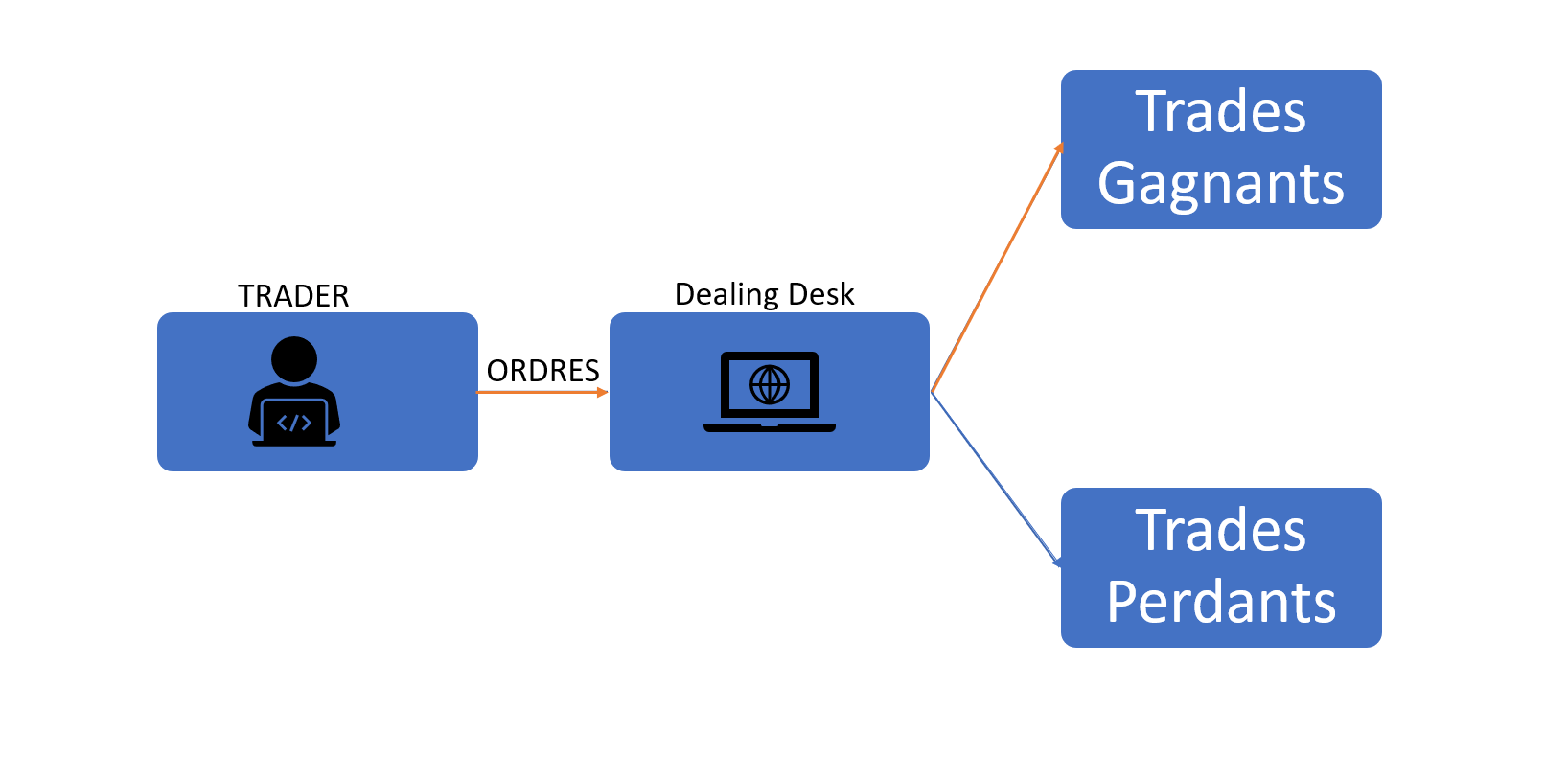
“Dealing Desk” literally refers to the trading or exchange desk. So what is a DD (Dealing Desk) broker? It is a broker with its own trading desk from which it handles its clients’ trades. It does not pass its clients’ orders on to the interbank market or the financial markets but executes and handles them itself.
This type of broker is called a market maker because, as just explained, it creates and manages the market in which its clients trade. It is the counterparty to their orders. As a result, when you (as a trader with a market maker) make a winning trade, the broker loses, and vice versa. Market makers earn their income mainly from spreads (the difference between an asset’s buy and sell prices).
No Dealing Desk Brokers
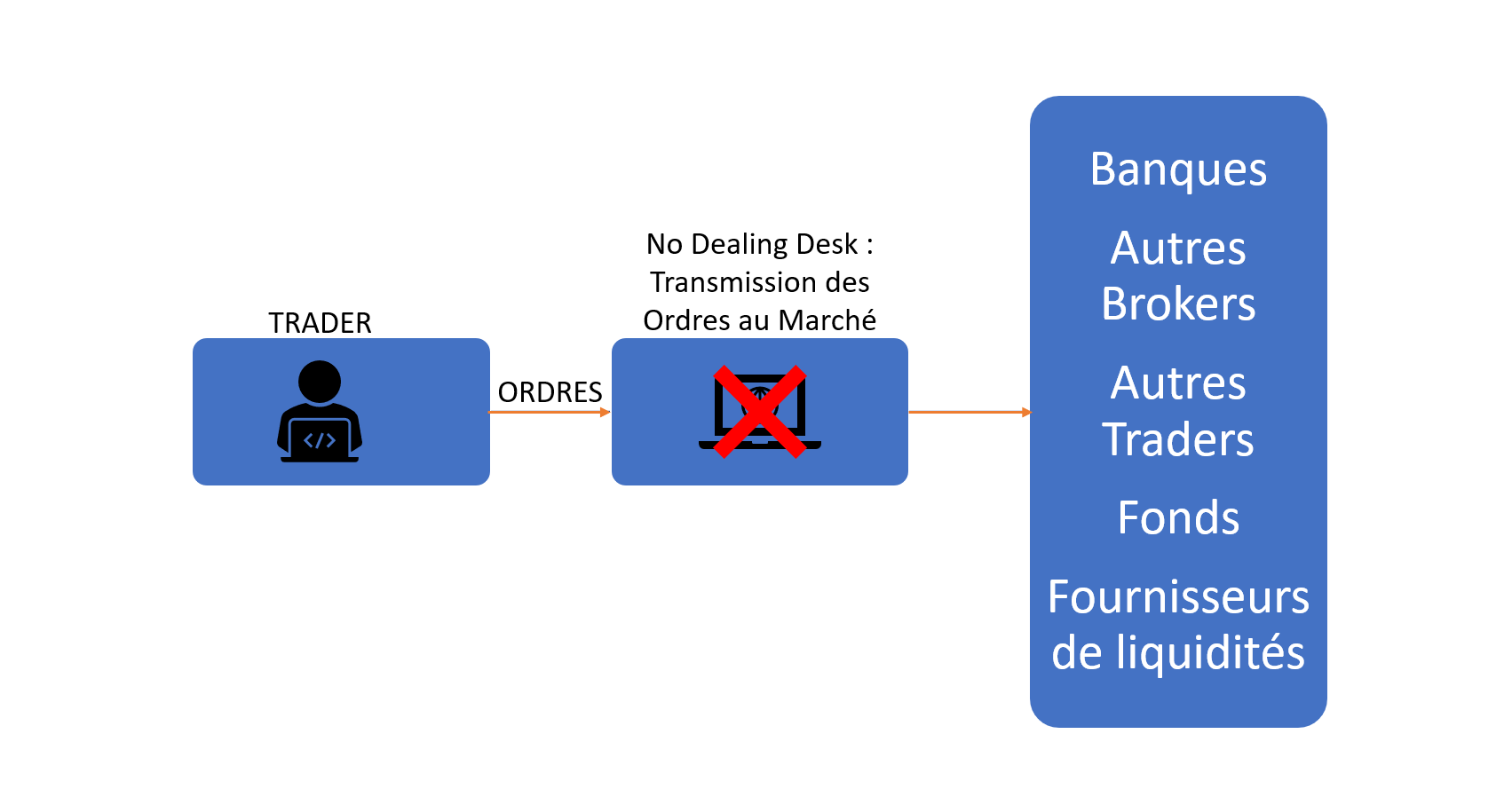
An NDD (No Dealing Desk) broker, on the other hand, limits its activity to intermediation. In principle, it simply passes its clients’ orders on to the markets, aggregates them and matches them. It does not handle its clients’ trades itself and is not their counterparty.
The most common types of NDD brokers are STP (Straight Through Processing) and ECN (Electronic Communications Network) brokers. In basic terms, with an ECN broker, when a trader wants to buy 1 lot of EUR/USD, for example, the broker matches this order with that of another trader who wants to sell 1 lot of the same EUR/USD pair and limits itself to this intermediation, whereas a DD broker would handle the trade itself and sell the asset to the trader.
ECN brokers offer very low, zero or sometimes even negative spreads, but they also charge commissions on trades, generally based on their volume.
Note, however, that a broker can be both a market maker and an ECN broker, offering some accounts that work on the market maker model and others on the ECN model.
Broker or Courtier?
Broker means “courtier” and refers to the same financial intermediary. Although the word broker is mainly used in English, it is also widely used and perfectly valid in French to refer to a courtier.
What Qualifications Do You Need to Become a Broker in 2026?
The broker’s job description presents them as responsible for intermediating between buyer and seller, and describes the profession as very accessible (unlike other jobs in finance). To get into this profession, a master’s-level degree (bac+5) from a business school or a finance specialisation is generally required. However, the profession remains open to a variety of profiles, such as a two-year higher education diploma (bac+2).
Brokers are simply expected to have qualities such as tenacity and good people skills. As they are in contact with clients all day long, brokers need good interpersonal skills and perseverance. They are also required to have a thorough knowledge of the financial products they are responsible for.
How Does a Broker Make Money?
Brokers have several sources of income, the main one being brokerage fees, which can take two forms:
Spreads. This is the difference between an instrument’s buy price and sell price, paid by the trader on each trade.
Commissions. These are not a price difference but simply fees, which may be fixed or vary with the volume of each trade. They are also charged on each trade.
In addition, Dealing Desk brokers can make money from some of their clients’ losing trades, and all types of brokers can earn a little extra from the various additional fees they charge (management fees, inactivity fees, etc.).
Also bear in mind that some brokers, particularly No Dealing Desk brokers, may charge both spreads and commissions on the same trade.
How to Tell Good Brokers From Bad Ones in 2026
Not all brokers are reliable, and even among reliable ones, not all can satisfy you equally. Here are the criteria for recognising a good broker:
Regulation. What is a broker? First and foremost, an intermediary whose activity is regulated, authorised and monitored by a competent authority. This is your guarantee that the broker will not act against you or disappear with your funds.
- Reputation. A broker with a reputation for satisfying its clients will probably do the same for you.
- User-friendly trading platform. In short, it must suit you (ease of use, interface, tools, etc.).
- Brokerage and other fees. These should be as competitive as possible.
- Security. The broker must guarantee excellent protection of your funds (segregation of funds, for example) and your data (SSL encryption).
When it comes to choosing a broker, you also need to consider criteria such as the speed and quality of execution, the quality and quantity of educational content, the minimum deposit, other fees (management, inactivity, etc.), trading and research tools, and so on.
Finally, a tip for spotting a bad broker is to check whether it appears on the blacklist regularly published and updated by the AMF or any other regulator.
What Is the Difference Between a Broker and a Trader in 2026?
Brokers and traders both operate on the financial markets in search of gains, but not in the same way or with the same prerequisites. The following table gives an overview of the main differences between a trader and a broker.
Do you use a broker as an intermediary in trading or another field? Feel free to share your experience with us by leaving a comment below!
Also read: HotForex Review · ClickTrades Review