 Leverage gives you real additional investment capacity in Forex, and brokers offer it to traders who want to invest in the currency market. But how does forex leverage work, how can you use it best, and which brokers offer the best leverage? That is what we invite you to discover in this article, entirely dedicated to this essential tool for becoming a profitable investor.
Forex Leverage Definition
Leverage is the ratio between the size of a position opened by a trader and their account balance. It is therefore a tool that lets you invest more than you have by, in a sense, “borrowing” the missing capital from your broker.
To go further, also read our guides “Forex Platform” and “How to Invest in Forex”.
Brokers’ Leverage on Currencies
★★★★★ 5/5 Vantage FX Review  Discover Vantage FX
| ★★★★☆ 4/5 AvaTrade Review 
| ★★★★☆ 4/5 FX Flat Broker Review
| ★★★★★ 5/5 XM Broker Review 
| ★★★★☆ 4/5 Pepperstone Review 
|
Where to Trade Currencies with Leverage
Generally speaking, leverage is available at every Forex broker on the market, and even on other asset classes such as stock CFDs, stock indices and cryptocurrencies. But you will soon notice that leverage is not the same at every broker.
In addition to the European regulatory limits set by ESMA, which we detail below, the leverage offered varies according to each broker’s own conditions. Each broker decides for itself the leverage allowed on its assets, in line with its own risk/reward strategy.
Note also that the leverage offered differs depending on whether you are a retail trader or an investment professional.
Finally, the type of Forex currency pair also affects the maximum leverage available, as follows:
- Major currency pairs generally have maximum leverage of 1:30
- Exotic currency pairs have maximum leverage of 1:20
However, some brokers that are not regulated under ESMA rules, such as Vantage or Axi, allow retail clients to use much higher leverage.
What Is the Best Forex Broker for Trading with Leverage?
Based on our comparison, the best Forex broker for trading with leverage appears to be Vantage, which, as well as offering higher leverage for retail clients, offers other advantages, including the MetaTrader 4 and 5 platforms and a large number of major and exotic currency pairs.
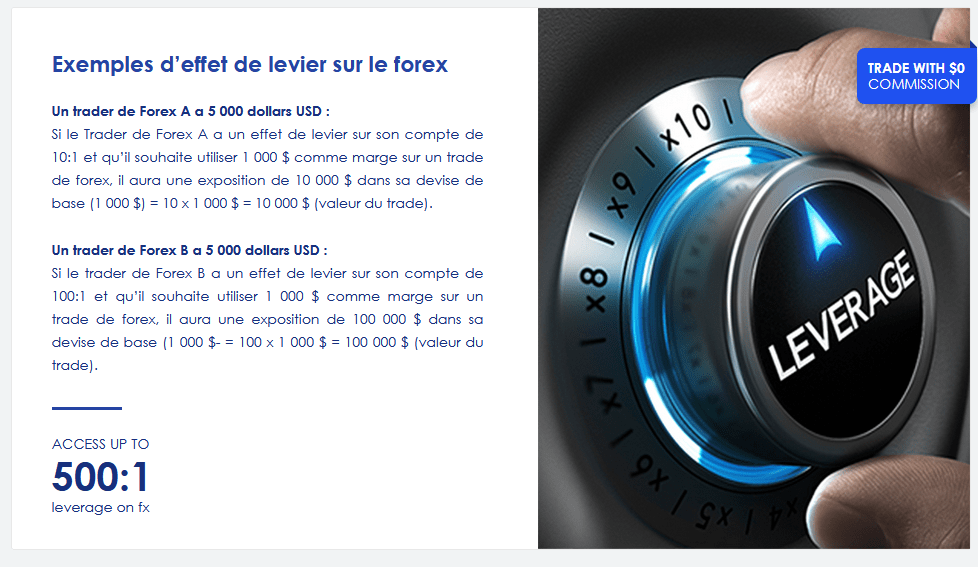
What Is Leverage in Forex?
First, let’s take a moment to give you a clear and simple definition of leverage in Forex.
Leverage is a mechanism that lets you increase the size of a position in Forex. More precisely, it is a tool that allows the trader to increase their investment capacity.
Forex leverage can be used for both selling and buying, and it lets you make larger trades whose total value can exceed the amount the investor actually holds in their live trading account.
As we will see below, leverage is closely linked to margin. Remember that the value of a trading account is made up of the capital used for open positions and the remaining capital available for opening future positions. So when the margin required by the broker to keep positions open is no longer available in the account, the trader receives a margin call.
How Leverage Works
To understand forex leverage and what it is for, you first need to understand how it works.
In short, when you trade Forex with an online broker, using leverage amounts to a kind of loan from the broker to the trader, who is treated as a borrower.
But to ensure the trader does not end up with a negative balance if the market moves the wrong way, the broker specifies the margin for each asset, i.e. the capital needed to cover the risk. Margin therefore often mirrors leverage. For example, with leverage of 1:30, you need €1 of available margin to finance a €30 position.
In concrete terms, leverage of 1:30, or 30x leverage, lets you make gains 30 times larger than the actual gains, but it also multiplies any losses by 30. While leverage is a tool that traders on the Forex market particularly appreciate, it should therefore be used with caution and strategy.
Leverage is especially useful for day trading or short-term trading strategies, as it lets you make larger profits from small price moves. Traders who opt for longer-term investment strategies tend to use low leverage or none at all.
As we will see in more detail below, the maximum leverage you can use in Forex is 1:30 if you are a retail trader, but it can go much higher for professional traders. This leverage level also varies with the currency pair traded and the broker, hence the value of comparing beforehand.
How to Calculate Leverage
Let’s now go a little further and look at the formula used to calculate leverage in Forex trading. Leverage is obtained with the following formula:
Leverage = Position size / equity
But be careful! Your leverage will also change once your position is open, depending on how it performs. Since leverage is directly linked to equity, a winning position lowers your trading leverage because equity rises, whereas a losing position increases leverage.
Simple Example of Leverage Calculation on the Currency Market
Let’s put this leverage calculation into practice with a simple, concrete example.
What is the leverage of a €30,000 position with €10,000 of equity?
Here, leverage equals the position size divided by equity, i.e. 30,000 / 10,000 = 3.
What is the position size with leverage of 3 and €10,000 of equity?
Here, the calculation is equity multiplied by leverage, i.e. 3 x 10,000. This gives a maximum position size of €30,000.
Example of a Leveraged Forex Trade
Let’s now look more concretely at how a leveraged Forex trade works.
Imagine you are a trader with €1,000 of capital in your trading account. Without leverage, you could only open one Forex position, since the minimum position size is 0.01 lot, i.e. €1,000.
Now imagine your broker offers you leverage of 1:30. You could then open a position of up to €30,000, or choose to open several smaller positions to diversify your trades and limit risk. So with only €1,000 in your trading account, you can put up to €30,000 on the market.
But what does using this leverage really mean for the trade? It is important to understand that 1:30 leverage also produces bigger gains from small price moves. A €1 gain without leverage becomes a €30 gain with leverage.
Of course, you also need to remember that potential losses are multiplied by this leverage too. A €1 loss will therefore become a €30 loss.
Maximum and Minimum Leverage on the Currency Market
The leverage available to you in Forex trading varies according to several criteria, including the broker’s regulator and, for ESMA-regulated brokers, the type of currency pair.
- ESMA regulation: 1:30 for major currency pairs and 1:20 for exotic currency pairs
- FCA regulation (UK): 1:30
- ASIC regulation (Australia): 1:30
- VFSC regulation (Vanuatu): 1:500
- CIMA regulation (Cayman Islands): 1:500
How to Increase or Decrease Your Leverage
Of course, you are perfectly free to raise or lower the leverage applied to your positions according to your strategy. There are, however, some rules to know:
- Increasing leverage – From your trading account, you can raise your leverage up to the maximum offered by your broker, provided you have the necessary margin in your account.
- Decreasing leverage – You can also choose to switch to lower leverage. Note too that when your account balance covers your entire position, or rises thanks to a winning position, your leverage falls automatically.
How to Use Leverage on the Currency Market
Using leverage on the currency market is fairly simple. Here we will look more precisely at the steps to follow to access it, then how to set it up and use it.
How to Access This Tool in Forex
First of all, you can use CFD stock market leverage or Forex leverage by choosing to trade online through one of these brokers. The first step, if you have not done so yet, is to open a live account with a broker and deposit your investment capital.
Note also that most of the time, brokers offer the same leverage on their demo accounts as on their live accounts. So you can test leverage and its effects virtually before getting started with your own capital. Here, of course, the gains will not be real.
Setting Up and Changing Leverage
Now let’s move on to practice, with the steps needed to set leverage on a Forex position.
- Log in to your client account from the interface provided by your broker.
- Go to your trading account settings to set your leverage.
- If you are a retail client, the maximum leverage available on currency pairs will be 1:30. You can work out which leverage to choose by selecting the lower leverage that suits you.
- If you are a professional, the leverage available to you can be much higher and is fully customisable.
- Then confirm your choice and the leverage will be applied automatically to your position.
Note that you can also change the leverage on your account to suit your preferences once it has been set.
Tips for Trading Currencies with Leverage
Leveraged Forex trading is a delicate exercise, but it can make you a lot of money if leverage is used correctly. Here are a few tips to help you trade Forex well with leverage:
- Choose your leverage carefully – First, the leverage level you use should not be chosen lightly. As we will see below, it will depend mainly on your profile and your level.
- Choose your assets carefully – The choice of assets, here currency pairs, that you trade with leverage is also important. Leverage can be useful in a market with average or low volatility, but it can become dangerous when volatility is higher.
- Choose your broker carefully – It may seem obvious, but choosing the right broker is essential for a strategy that includes leverage. You need a reliable broker, ideally regulated by the financial authorities, that also lets you fine-tune your leverage.
- Manage your capital well – We will come back to this in more detail below, but money management is also essential if you want to trade Forex effectively with leverage.
- Assess the risks properly – Finally, you also need to understand the risks you run with forex leverage, without being overly cautious.
How Leverage Affects Your Gains and Losses
As you now understand, forex leverage affects the size of your position, but also, and above all, your gains and losses. Using high leverage can greatly increase your chances of making money, but it can also significantly increase your losses.
In short, the gains and losses on a leveraged position are multiplied by the leverage level. To better understand the impact of leverage on a Forex position, let’s take a few concrete examples:
Imagine you open a position on EUR/USD with €1,000 of your own capital.
Case 1: Without Leverage
Without leverage, your position here will be €1,000, i.e. 0.01 lot. If EUR/USD rises by 5%, your gain is 5%, i.e. €50.
If EUR/USD falls by 5%, your loss is 5%, i.e. €50.
Case 2: With 1:30 Leverage
If you use the maximum leverage allowed for retail clients, namely 1:30, your position will be €30,000, i.e. 0.3 lot. If EUR/USD rises by 5%, your gain will no longer be 5% but 150%, i.e. €1,500.
In the same way, if it falls by 5%, your loss will be €1,500.
*Note that most regulated brokers apply negative balance protection to accounts. As a result, in this particular case, the maximum loss will be 100%, i.e. €1,000. The position will be closed automatically at that level.
Before each entry, also work out your risk/reward ratio to confirm that the targeted gain justifies the risk taken.
Case 3: With 1:500 Leverage
Now imagine you are a professional trader using 500x leverage. Here, your position will be €500,000.
If EUR/USD rises by 5%, your gain will be 2,500%, i.e. €25,000.
Likewise, if EUR/USD falls by 5%, the loss will be 2,500%, i.e. €25,000.
Impact of Leverage on Transaction Costs
Apart from the effect of leverage on gains and losses in Forex, you also need to take into account its impact on the cost of the trades themselves.
Remember that Forex brokers do not charge commission on trades but earn their money through the spread, which is a small difference between the buy price and the sell price of a currency pair.
Since this spread is applied directly to the price when the position is opened, leverage also magnifies it, which is an additional cost to take into account.
Going back to our previous example, a €1,000 position on EUR/USD with a 2-pip spread and leverage of 30:1 means each pip is worth €3. The cost of this trade will therefore not be €0.2 but €6.
Complete your leverage analysis with the exact value of your pips.
This is important to understand, because traders who lose money through leverage do so mainly because they do not take this risk sufficiently into account and do not include these costs when calculating their potential losses.
You can, however, manage this risk so you are not penalised, for example by choosing lower leverage and investing only a small percentage of your capital in each trade.
Apart from this impact on the spread, using leverage in Forex is free. Although the broker is the lender of a form of capital advance, it does not charge interest on this “loan”.
What Is the Best Leverage for Currency Trading?
As we have seen, the choice of leverage for Forex trading depends partly on your preferences, but above all it should depend on your strategy. Here is the average leverage used by Forex traders according to their investment style:
- Forex leverage for day trading or scalping – For very short-term strategies such as scalping or day trading, it is better to use high leverage. Ideally this will be 1:30 for retail clients and between 1:50 and 1:500 for professional traders. The goal, of course, is to generate as much profit as possible on short positions.
- Forex leverage for swing trading or long-term trading – Longer strategies do not require high leverage and can even be implemented without leverage. If you still want to use leverage for these positions, limit yourself to 1:5 if you are a retail client and 1:20 if you are a professional.
Remember that choosing the right leverage is particularly important, especially if you are new to Forex or have little experience. The highest ratios should only be used to capture small market moves in order to generate sufficient profits.
You therefore need to know the optimal leverage for your trading strategy to be effective and to make the most of the best opportunities.
If you are unsure which leverage to use on a given Forex currency pair, do not hesitate to use your demo account to test different ratios and find the one that best suits your way of trading.
What Is the Ideal Leverage for Your Investor Profile?
Of course, the ideal forex leverage also depends on your investor profile and the capital you have. Remember that you must have enough of your own capital to keep your positions open when the market does not move as expected. The rule to follow is:
- Ideal leverage with small capital – If you have little investment capital, you will probably want high leverage to benefit from larger position sizes. However, since your losses will also be magnified by that leverage, it is better to choose lower leverage to limit the risks.
- Ideal leverage with large capital – If you have substantial funds to invest in Forex, you can also look to increase your gains with high leverage. This is more appropriate here, since you will have enough margin to manage the risks, ideally by taking smaller positions.
The Best Leverage for Beginners
While the perfect forex leverage depends on many criteria, your level of knowledge of the currency market and of stock market investing also affects this choice.
So if you are a beginner, we advise you to try leveraged trading with a low ratio first. This will let you get used to market movements and avoid the most common mistakes among novice traders, such as letting losses run or overexposing yourself by committing all of your margin.
Starting with low leverage will stop you losing a lot of money through simple mistakes. Once again, testing forex leverage on a demo account can be a good idea here.
The Best Leverage for Professional Traders
Traders with a professional account are often more seasoned investors, and they have higher maximum leverage than retail accounts.
High leverage is essential for them because it lets them tie up less margin. They can then manage their positions according to market volatility and the opportunities available.
In addition, an experienced trader can calculate their leverage and risk level precisely and applies reliable, effective money management.
However, while the maximum leverage available to professional traders is high, the leverage they actually use is often lower and depends on how they manage the size of each position.
 Diversifiez votre patrimoineInvestissez dans l’artDes tableaux originaux, pièces uniques signées par l’artiste. Un actif tangible, loin des écrans et des cotations.Voir les tableaux →
Advantages and Limits of Leverage on the Currency Market
Advantages | Disadvantages |
|
|
The Benefits of Leverage
As you will have understood, using leverage in Forex has many benefits. Here they are in detail:
Make More Money with Leverage
First, the main advantage of leverage is that it lets you earn more. When you invest with leverage, you only invest part of your own capital and, in a sense, borrow the rest from your broker.
So when the market moves in the direction of your position, you can make much more attractive profits, all the more so if your leverage is high.
This is especially worthwhile if you trade short term, and therefore with small price differences between opening and closing your position.
Diversify Your Investments with Leverage
Since leverage lets you invest a smaller share of your capital, you can use it to invest in several currency pairs at the same time, and even diversify your positions further by investing in other assets through CFDs.
Good diversification is the foundation of any good trading strategy, and leverage makes it easier.
Improve Your Strategies with Leverage
While strict discipline is needed to perform well in Forex, this is even more true with leverage.
When you use leverage on your Forex positions, you have to set yourself a clear strategy and a course to follow. Your emotions will therefore have less influence on your decisions. You will also be more inclined to use loss-limiting and profit-taking tools such as take profit and stop loss orders.
The Limits of Leverage
Of course, leverage does not only have advantages. It also has some drawbacks and limits, including the risk of losing more money. Here is a summary of its main weaknesses:
Higher Risk of Capital Loss
This is the main drawback of leverage and the flip side of higher potential gains. While leverage lets you make more money when the market moves in your favour, the losses incurred are also bigger when the trend goes against you.
That is why beginner traders should preferably choose low leverage or start by practising on a demo account to understand these risks and learn to anticipate them.
A Stronger Emotional Grip
Naturally, since the risks are greater with leverage than without, your emotions will be sorely tested.
Fortunately, you can limit the stress caused by an open leveraged Forex position, first by only investing what you are prepared to lose, and also by applying strict, calculated money management.
The advice here is to define a clear strategy in advance and stick to it, whatever you feel.
How to Manage Your Leverage When Trading Currencies
While forex leverage can help you take more attractive positions and generate more gains, it must be used wisely given the risks of loss it carries. Fortunately, there are a few tips for managing your leverage well, detailed below:
Create a Trading Plan
First, when trading with leverage, it is essential to draw up a trading plan or trading strategy beforehand. Before opening a position, you must define precisely your targets for both gains and losses, and stick to them without letting your emotions take over.
To make sure you follow this trading plan reliably, write it down using a dedicated tool or an Excel spreadsheet. Above all, use every analysis tool at your disposal to set your targets.
Put Good Money Management in Place
The most successful Forex traders are probably those who trade with leverage while applying high-quality money management, or risk management.
You always need to know the margin used by a position and set the maximum loss with a stop loss if you cannot follow the market live. Money management is essential because it lets you close a losing position before the leverage used makes you lose all your capital.
A few simple rules can greatly reduce the risk of loss, such as avoiding investing a large share of your capital in a single position. In general, a maximum of 5% of capital per investment is ideal. In short, here are the rules of good money management:
- Calculate precisely the maximum loss you are prepared to take, taking into account swaps, spreads and any commissions.
- You can also use money management software.
- Stick to your initial strategy without letting emotions take over.
- Keep an eye on the market environment and the currency pairs you follow.
Use Stop Loss Orders
It is strongly discouraged to open a leveraged Forex position without protecting it with a stop loss. Remember that leverage in Forex can lead to large, rapid losses if the price moves the wrong way or the trend reverses sharply.
So to avoid the risk of emptying your Forex trading account, you should, taking your leverage into account, place a stop loss order that will close your position at a set level.
It is better to take a losing position than to wait for a reversal which, if it does not come, will leave you unable to open a new position.
Your stop loss level will be determined by your strategy. Note that Forex brokers also often offer stop-loss calculators to help you work out the best level to cut your losses, with or without leverage.
How Much Money Can You Make with Leverage?
This is a question many traders interested in Forex and leverage ask themselves. It is well known that leverage can genuinely improve a trader’s financial returns on the markets, so it is common to make money by using this tool.
It is in fact particularly difficult to make money in Forex without leverage unless you have very large capital, because price moves are relatively small and volatility is lower than on other markets.
While leverage itself does not determine the investor’s performance, it does affect the size of both gains and losses.
Clearly, if you make a series of winning trades with high leverage, you can make a lot of money in a short time. But your strategies still have to perform. Remember that, conversely, a series of losing trades with high leverage can make you lose all or a large part of your capital.
To truly optimise your gains and grow your trading account over the long term, it is therefore essential to use leverage carefully and sparingly, with a simple but strict strategy.
Can You Trade Without Leverage?
Although all Forex brokers now offer their traders the option of speculating with leverage, using it is by no means mandatory.
However, on the currency market you will need large capital to hope to make money, and sometimes even to open a position without leverage. To open a position without leverage, you must have the entire amount needed in your trading account.
In addition, trading without leverage generates much less income than trading with leverage, even though it also reduces the risks.
Not sure whether to invest with or without leverage? Then ask yourself a few questions about your strategy, market volatility, your capital, your goals and your risk aversion.
- What is your investment horizon? – The shortest strategies will need leverage, whereas long-term investing can sometimes be done without it.
- How volatile is the market? – High market volatility should push you to reduce your leverage, as volatility significantly increases the risk involved.
- How large is your capital? – If your capital is small, you will definitely need leverage to invest.
- What is your goal? – Of course, if your aim is to make a lot of money quickly, you will need leverage, but you will have to accept the risks.
- How risk-averse are you? – Strong risk aversion should, on the contrary, push you to trade without leverage or to use lower leverage to limit potential losses.
Other Leveraged Products and Markets
Apart from Forex and currencies, there are other products and markets that allow leverage. Here is a summary of the different assets and instruments you can trade with this tool.
Leveraged Products | Leveraged Markets |
|
|
Note that the Forex market is probably the best suited to leverage, given the small price moves of currency pairs. A currency pair rarely moves more than 1% in a session, whereas some other securities, such as currencies, sometimes move more than 10% a day.
This is also why the leverage offered on other markets is lower than on Forex.
The Risks of Leverage on the Currency Market
Margin and leverage limits exist in Forex above all because of the risks traders may face. Remember that leverage creates an illusion of large funds, and therefore risks that can affect trading performance. Fortunately, the risks of forex leverage can be limited.
Understanding Margin and Leverage
To fully understand the risks of leverage in Forex, it is also important to know and understand another key term: margin. Have you ever wondered how a broker can provide its traders with so much money when they use leverage? In reality, margin acts as a safety net for the broker and lets it recover the funds advanced, whatever happens.
In short, margin is the minimum amount you must have in your account to keep your positions open.
This means margin is, in a sense, the broker’s insurance. When you open a new position, the broker locks this margin, which guarantees that your balance cannot go negative.
As we will see below with the details of the margin calculation, the size of a margin depends on both the number of lots and the leverage. So the higher the leverage, the lower the margin you will have to put up. Remember that while leverage is expressed as a ratio, margin is expressed as a percentage of the total position size.
How to Calculate Margin
Calculating the required margin means applying a percentage, called the “margin requirement”, to the position size. This margin is calculated in the base currency of the currency pair and, when that currency differs from your account’s base currency, the margin amount is converted into your currency.
So when the base currency is the same as the account currency, you simply multiply the position size by the margin requirement to find the required margin.
When the base currency differs from the account currency, you multiply the position size by the margin requirement, then multiply the result by the exchange rate between the base currency and the account currency.
There are also three different types of margin:
- Required margin – This is the basic margin term, meaning the amount needed to keep a position open. Required margin varies by trade and is locked upfront.
- Used margin – This is the sum of the required margins of all the trader’s open trades. This amount is therefore unavailable for opening other positions. Note that on the MetaTrader platform, the term “margin” refers to used margin.
- Free margin – Finally, as the name suggests, free margin is the margin the trader still has available for opening new positions.
The Link Between Margin and Leverage
There is therefore a close link between margin and leverage. In short, a margin account lets the trader use leverage. To calculate the required margin, you divide one by the leverage ratio. With leverage of 1:100, for example, the required margin will be 1% of the position size.
Leverage Limits in Europe
Since leverage tends to amplify the effect of volatility in Forex, it is increasingly regulated and supervised. For brokers regulated in the European Union, ESMA (the European Securities and Markets Authority) is responsible for supervising the financial markets and sets the limits on forex leverage.
In 2018, ESMA laid down strict rules on leverage limits by asset type. This regulatory reform, requested by the European financial markets authority, is above all intended to protect retail investors against excessive leverage, which is sometimes poorly managed and poorly understood.
Regulation of Leveraged Trading for Retail Clients
To better understand the restrictions ESMA imposes on leverage in trading, here is a summary table of the maximum leverage allowed and the associated margins:
Asset type | Max Leverage | Associated margin |
Currency pairs | 1:30 | 3.33% |
Stock Indices | 1:20 | 5% |
Commodities | 1:10 | 10% |
Cryptocurrencies | 1:2 | 50% |
Stock CFDs | 1:5 | 20% |
Gold | 1:20 | 5% |
Regulation of Leveraged Trading for Professionals
Regulation of leveraged trading in Forex and elsewhere does not only concern retail clients but also professional traders. However, as the table below shows, the restrictions are much lighter here, since access to a professional account is subject to strict conditions.
Asset type | Max Leverage | Associated margin |
Major Currency Pairs | 1:500 | 0.2% |
Exotic Currency Pairs | 1:25 | 4% |
Major Stock Indices | 1:500 | 0.2% |
Other Stock Indices | 1:100 | 1% |
Commodities (Gold, Silver, WTI, Brent) | 1:500 | 0.2% |
Other Commodities | 1:100 | 20% |
Cryptocurrencies | 1:20 | 5% |
Stock CFDs | 1:20 | 5% |
Key Takeaways
In short, here is what you need to remember about forex leverage:
- Leverage is a loan of capital from the broker, designed to maximise positions and profits.
- In Forex, position size is measured in lots, and a standard lot is 100,000 units of the base currency. So a one-pip move in EUR/USD represents a loss or gain of $10.
- Using leverage involves margin, which is a minimum amount of capital to deposit in the account.
- Leverage is regulated by ESMA but can vary according to the broker and its own regulator. It is higher for traders with a professional account.
- Finally, using leverage requires good money management.
Our Verdict
In our view, forex leverage above all lets you make bigger, and therefore more attractive, capital gains when combined with an effective strategy. But misused, it obviously carries significant risk, and losses can also be very large. It is therefore essential to use leverage wisely, especially if you are a beginner investor.
There are, however, safeguards that help manage the impact of leverage, notably margin and legal restrictions such as ESMA’s. In addition, some brokers offer negative balance protection to further protect their traders.
Of course, the choice of broker you use for leveraged trading is very important. If you are looking for high leverage, you will turn to a broker regulated outside the European Union or the United Kingdom. If you want a safer broker with low leverage, ESMA-regulated brokers will be preferable.
Finally, since good practice is needed to use leverage in optimal conditions, choosing a broker with a demo account is also a good idea.
Conclusion – What Is the Right FX Leverage for You?
The best forex leverage for you is above all the one that matches your level of experience and your profile. The leverage you use will depend on the capital you have to invest, your risk aversion and the strategy you plan (short-term or long-term trading).
As for the best broker for forex leverage, we recommend Vantage, which, in addition to offering leverage of up to 1:500, provides a demo account and the MetaTrader 4 and 5 trading platforms, which we consider ideal for setting up protected leveraged positions.
Using leverage is also almost essential for trading Forex and should not be feared. It can significantly improve your gains and be used profitably when managed effectively. Once you have learned to master this tool, you will be able to take full advantage of all its benefits.
Read also: Forex France
Have you tried leveraged Forex trading? Share your experience and your opinion of this tool in the comments.