 Find out how Orange dividends are calculated and paid. Although its share price has been affected by the COVID crisis, Orange decided to pay increased dividends to its shareholders in 2025. Are you looking to buy Orange shares to receive dividends?
Orange on the Stock Market: Orange Dividend History
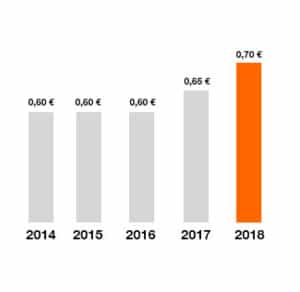
Exercices | Dividendes | Variation | Type Dividende |
2022 | $0.400 | -33.33% | Ordinary |
2021 | $0.600 | 0% | Ordinary |
2020 | $0.600 | 20% | Ordinary |
2019 | $0.500 | -28.5% | Ordinary |
2018 | $0.700 | 7.69% | Ordinary |
2017 | $0.650 | 8.33% | Ordinary |
2016 | $0.600 | 0.00% | Ordinary |
2015 | $0.600 | 0.00% | Ordinary |
2014 | $0.600 | -25.00% | Ordinary |
2013 | $0.800 | 2.56% | Ordinary |
2012 | $0.780 | -44.30% | Ordinary |
The 2019 financial year was a fairly difficult one for Orange, which suffered considerable losses with the coronavirus health crisis. However, given its 2020 performance, the company’s business has clearly improved, and it could pay larger dividends in 2025.
If this topic interests you, also see “SEB Dividend” and “Sanofi Dividend“.
Orange Stock Forecast: Orange’s Next Dividends
In line with its dividend distribution policy, Orange pays its dividends in 2 phases: a first phase for the interim dividend and a second phase for the final dividend. For the past year, the interim dividend will be paid in the last quarter of the current year and the final dividend during the following year.
The current year has been exceptional: Orange has performed well but wishes to maintain the dividend amount. It will pay the same amount as last year, and payment will be made in two phases as usual. An interim dividend will be paid in December 2025 of €0.30. The rest will be paid at the extraordinary general meeting to be held in 2025, at which the final dividend will be determined.
Orange Dividend Payment Date
Orange does not pay its dividends on a fixed date, but it always does so in two phases. These payments are generally made in the fourth quarter of the current year and the first quarter of the following year. The fourth-quarter payments are an interim dividend and those of the first quarter are the final dividend. When the advance payment is made, the company sets the date on which the rest will be paid and proposes any necessary arrangements.
For 2025, the interim dividend will be paid in December and the final dividend will be paid after the board decides on the date of the next payments.
Orange Ex-Dividend Date
Going ex-dividend means separating the dividend from the share, based on the share’s last market value. The ex-dividend date usually falls a few days before payment. For the current financial year, Orange will pay its interim dividend on December 15, according to management in a press release. The ex-dividend date will therefore be a few days before or on that day.
Payment of Orange Dividends
Orange dividends are paid in two phases: a first phase for interim dividends during and toward the end of the year concerned, then the final phase. The final dividend is paid during the following year.
So far, Orange has always paid its dividends in cash, as most companies do. However, other circumstances could lead management to pay in shares.
After the ex-dividend date, dividends are paid into the shareholders’ accounts or via any payment method the shareholder has indicated that is consistent with company policy.
The interim dividends will be paid on December 9, 2025 for the current year; the company has not yet set the payment date of the final dividend. The interim dividend has been set at €0.30 per share, and the rest will be determined later.
Orange Stock: How Are Orange Dividends Calculated?
Companies calculate the dividends to be paid in various ways, depending on their management policy. It is important to know how Orange calculates its dividends before venturing into any investment.
There is no rule or mathematical formula from which the company determines the value of its next dividends. At Orange, dividends are calculated and proposed at general meetings by management. They are then paid after approval by the meeting. The amount depends mainly on the company’s performance during the current year and its forecasts for the following year.
Shareholders can, however, estimate the dividends they might receive by running a simulation based on the current year’s performance.
 Diversifiez votre patrimoineInvestissez dans l’artDes tableaux originaux, pièces uniques signées par l’artiste. Un actif tangible, loin des écrans et des cotations.Voir les tableaux →
Orange Stock Forecast: Next Orange Dividends
Several analysts expect a good market performance in 2025, a forecast supported by the stock’s recent performance. Looking at the chart, the share price has been trending mostly upward for some time.
Most analysts in the consensus recommend buying the shares, while others recommend holding them in light of current performance. They clearly remain hopeful despite the stock’s track record.
The last two years have been difficult for shareholders, as the health crisis heavily affected the company’s performance. Orange suffered considerable losses this year and a significant fall in its market value. This has led several investors to question the company’s performance for next year.
Orange Dividend: Taxation of Orange Dividends
Taxation on shares depends on the type of account, which can be a PEA or a securities account. Orange’s distribution approach differs from that of other companies, as is the case with Peugeot, TechnipFMC, Nike or EDF dividends. It takes into account the situation of securities accounts and that of PEAs.
Orange Dividend Taxation in a PEA
Dividends in a PEA-PME are only subject to a flat levy of 17.2%. However, shares in a PEA must be held for 5 years or more, not less. This means the shareholder can only recover their investment after holding it for at least 5 years.
Orange Dividend Taxation in a Securities Account
For Orange dividends, some are taxable and some are exempt. Orange has introduced this policy to favor certain shareholders.
- If you hold C units, you pay no tax, no social charges and even fewer fees.
- If you hold D units, you pay the standard flat tax (PFU) of 17.2% social charges and 12.8% income tax.
Orange Dividend Yield in Recent Years
Period | Changedu Cours | Highest Price | Lowest Price |
1 year | -0.45% | 10.87 | 8.63 |
3 years | -30.81% | 15.38 | 8.63 |
5 years | -29.31% | 15.80 | 8.63 |
10 years | -16.90% | 16.38 | 7.03 |
Orange has posted an average yield of 5.78% over the last 10 years. The dividend yield is calculated using the following formula: Yield = Dividend / Share price.
Our Opinion on Orange’s Dividend Policy
Despite a significant fall in its share price, Orange paid large dividends to its shareholders in 2025 for 2020. It chose to pay €0.90 per share, a considerable increase on the previous year’s dividends.