To invest in the markets, you need a trading strategy. Swing trading is one of the most popular investment methods in the world and can be a great advantage for beginners. Interested in this type of investing? Discover everything you need to know about swing trading: definition, how it works and profitability.
What Is Swing Trading?
Swing trading definition: a longer-term way of investing in the markets that allows you to make profits frequently. The term combines two English words. “Swing” refers to the swings, or movements, in the market. “Trading” refers to buying and selling assets on the financial markets. The combination of the two comes from the fact that this strategy involves analyzing past price movements and the likelihood that they will happen again.
The key point is that swing trading is a specific way of trading that sits between the medium and long term. In other words, it spans a few days or a few weeks, and can even last months. Finally, it relies mainly on historical analysis using technical indicators.
To go further, also read our guides “Best Trading Signals” and “Small Caps Trading”.

How to Trade Using a Swing Strategy
Swing trading is one of the main trading basics techniques. Here is how swing trading works in general. Start by analyzing the market you want to trade, using technical and fundamental analysis, which we explain below.
After this analysis, the idea is to enter a position at the right time according to the strategy you use. Once in a position, set a stop loss (exit point if you lose) and a take profit (exit point if you win). Your positions are held until one of these limits is reached, which can take several days or weeks. Hence the description “longer-term trading”.
To make it clearer, here is a simple swing trading for beginners example.
 Suppose a trader decides to invest in stocks. They spot company X’s share, already priced at €100, and decide to trade it. They analyze the market and expect the price to rise, so they take a long position with the following settings:
- Stop loss: €20
- Take profit: €250
Now all they have to do is wait for one of these limits to be hit. Market fluctuations will move the price of share X over several days or weeks. When the price reaches €250/€20, the position closes and they gain or lose the difference between the entry price and the new market price.
Steps to Follow
To trade using this trading strategy, follow these steps:
- Choose the right broker: select the best broker offering the best conditions in terms of fees, instruments and security for longer-term trading.
- Choose the asset to trade: not all market products suit this form of investing, so you need to find the right instrument. Examples include stock indices such as the CAC 40 or DAX 40, and commodities such as gold and oil. Some Forex currency pairs can also be used for swing trading.
- Deposit money: fund your account to trade
- Choose how long to hold your positions: using this trading style properly means holding positions for longer. You can keep positions open for a few days, weeks or months, depending on your prior analysis.
- Choose your strategy: there are specific investment strategies for this trading style. Choose the one that suits you best.
Once you have set these parameters, you need to test your strategy. To do so, simply place your orders on the chart. This shows you the opportunities and risks of your strategy so you can make adjustments. A final test is needed, this time under real trading conditions. Once that is done, all you have to do is execute your swing trade.
The Best Broker for Swing Trading
If you are looking for the best broker to invest with, we recommend three main brokers:
These brokers are all good quality, so we cannot say objectively which is best for swing trading. Each excels depending on the type of instrument you want to trade with this strategy.
Vantage is the ideal broker if you want to swing trade indices and Forex. It offers all the major international stock indices, and its spreads are very low.
If you are more interested in commodities, Axi is the best broker for the job.
To start investing with this strategy, these are the brokers you should explore first. You won’t find better.
The Best Market for Swing Trading
Although nothing stops you using it for CFD trading, the stock market is the ideal place to apply a swing trading strategy, for a very simple reason: stocks are less volatile and highly liquid compared with Forex, for example. This makes it easier to anticipate upward or downward moves. As a longer-term strategy, swing trading suits this type of asset. Find out which site to use to buy stocks.
Holding a position for several days lets you take advantage of each move (impulses, corrections) according to your investment strategy.
Here is an example showing how well the stock market suits this trading method.
Suppose you are a swing trader who buys a company share at €100 to sell it at a higher price. You hold your position for 4 weeks. For the first two weeks, the share price is stable. At the end of the third week, the company publishes its quarterly results. They are good, triggering an upward move in the fourth week. The share is now worth €300. You close your position and pocket the difference between the two prices (€200) on each share sold.
This kind of situation is common on the stock market, which is why we think stocks are the best asset for this trading style.
Example of a Swing Trading Strategy
In this section, you will see how to apply a swing trading strategy from start to finish. We run a simulation on the MetaTrader 5 trading platform, using a very popular Forex trading pair, GBPUSD. Here is what to do.
Set Timeframes Suited to Longer-Term Trading
For longer-term trading, set your timeframes to several days or weeks. Depending on your strategy, open MT5 and choose one of the following timeframes:
- D1: daily timeframe
- W1: weekly timeframe
- M1: monthly timeframe.
These timeframes are a perfect fit for longer-term trading. You will find them in the MetaTrader toolbar: click “Charts”, then “Timeframes”, and choose the one you want from the three above.
In this example, we chose the weekly W1 timeframe, so the chart shows the pair’s movement over the previous week. The image below illustrates this.

Analyze the Market
Once you have set the timeframe, analyze the market you want to trade, using fundamental or technical analysis. This example uses technical analysis with the MACD indicator, which many investors use as the basis for their strategies.
To apply the MACD to your chart:
- go to the “Insert” tab in MT5
- Click “Indicators”
- Choose “MACD”
The chart will change again, showing the MACD lines (the signal line and the moving average line). The strategy is to enter a position whenever the two lines cross.

When the moving average crosses the signal line upward, open a long position. Otherwise, go short. When the moving average turns the other way, it is time to exit your positions. This is a simple strategy to apply in swing trading.
Pros and Cons of This Strategy
Swing trading has both advantages and drawbacks. The table below gives some details.
Pros | Cons |
|
|
Note: you can reduce the drawbacks of longer-term trading by choosing the right broker and a well-thought-out strategy.
Types of Swing Trading by Market
Swing trading is possible on virtually every type of market (though not necessarily effective on all of them). There are therefore several types of swing trading depending on the market, including:
- Forex: the currency pair market (EUR/USD, USD/JPY, AUD/CHF, etc.).
- Indices: they track the performance of the top companies listed on different exchanges, such as the DAX 40, DJ30 and CAC 40.
- Commodities: industrial raw materials traded on the markets, such as gold, oil, natural gas, cocoa and more.
- Bonds: debt issued by governments or companies.
- Options: this instrument gives the right to buy at the strike price or to sell on the expiry date.
- Contracts: agreements you make with the broker on a specific asset, such as contracts for difference (CFDs) and futures contracts (futures).
Besides these, there are other assets you can swing trade. You will find a list of all leveraged instruments in our beginner content.
What Is the Best Account for Swing Trading?
An account with no swap charges is ideal for this trading style. So should you choose a standard securities account or an Islamic account? Clearly, the second option is better. A securities account is a good way to trade stocks, but it charges swaps.
An Islamic account, on the other hand, charges no swaps. That is a considerable advantage when you want to hold positions for a long time, as you pay no overnight holding fees. You will save a lot, which will have a positive impact on your returns.
So remember that an Islamic account is the best account type for this trading method. Look for a broker that offers one without delay.
The Best Platform for Swing Trading
There is no one-size-fits-all answer to which platform is best for swing trading; it depends on your needs as a swing trader. In our view, the best swing trading platform is the one that gives you the most analysis tools, so our choice is MetaTrader, the most popular trading software in the world.
MetaTrader has built-in features that are essential for an effective swing strategy:
- Economic calendar
- Trade history
- Strategy tester
MetaTrader also offers trading signals, Expert Advisor robots and the PZ Swing Trading indicator for MT4. In short, everything you need to hold trades for more than a day is on MetaTrader. You can find MetaTrader at quality brokers such as:
Besides MetaTrader, eToro‘s trading platforms are also worth considering here. The eToro WebTrader is the best social trading platform in the world, meaning you can easily copy the trades of the broker’s best swing traders. Find out more about the brokers that offer these platforms.
Vantage: Best Forex Platform
 If you want to swing trade Forex, Vantage is the broker for you. It offers several trading platforms: on one side the MetaTrader software, and on the other MetaQuotes. With this broker, you can swing trade every currency pair in the world, within a framework regulated by the FCA, CIMA and VFSC.
Pros | Cons |
|
|
eToro: A Platform for Longer-Term Social Trading
 eToro is the leading social trading broker. It lets you find and copy the trades of the best investors, so you can do copy swing trading with this broker. eToro does not offer MetaTrader (the best platform for this), but it has the best stock offering (the best market for swing trading).
eToro offers the following platforms:
- Open Book
- eToro WebTrader
This broker is regulated by CySEC.
Who Is Swing Trading For?
Swing trading is open to everyone, whether you are a professional or a budding trader. However, it is best suited to people who don’t want to spend all day trading. So if you have other important commitments, this trading style is for you: you can place your trades and get on with other things.
Swing Trading Fees
The costs of swing trading depend on the broker you use. However, the fees brokers generally charge are well known:
- Spreads: the difference between an asset’s ask and bid price
- Commissions
- Conversion fees
- Swaps
Note: it is better to choose a broker that only charges spreads, so you can save more.
How Much Capital Do You Need for Swing Trading?
It is impossible to say exactly how much capital you need to swing trade, as it depends on the broker you choose and your requirements as a trader. Even so, we recommend having at least €10,000 before considering this style of investing.
In terms of minimum deposit, the most flexible brokers, such as Vantage, set an affordable minimum. However, you need to take into account how long you hold your position and the price of the asset. If you trade a high-profile stock such as Tesla (priced at $667.92 at the time of writing), you will need much more money to hold your positions for a long time. So prepare your balance accordingly.
When to Enter, How Long to Hold and When to Exit
In swing trading, you should enter a position at the precise moment the price is likely to move in the direction you want, i.e. when the trend is in your favor. The trigger is visible on your chart; compare historical data on past charts to spot it. Note, however, that the right entry point depends on several things:
- The direction of your position (long or short)
- The strategy you use
- The technical analysis used.
So how long should you hold your positions? There is no set answer. Hold them until you reach your profit target. At the very least, your trades should last more than 24 hours; otherwise, it is not swing trading. Finally, exit your position when you feel the trend is no longer in your favor.
As a general rule, these are the principles to apply, adapting them to the strategy you follow.
How to Analyze the Market for Swing Trading
There are two main ways to study the market for this technique: fundamental analysis and technical analysis. In this section, we show you how to analyze markets using both.
Fundamental Analysis
Fundamental analysis infers market movements from related information. The stock market is the best illustration: fundamental analysis assesses a company’s financial health. If the company is doing well, its share price is likely to rise, prompting you to take a long swing trading position.
If the company’s financial results are disappointing, the market will probably trend downward, so you will need to sell your shares.
Fundamental analysis relies on the following data:
- The company’s sales figures
- Profits made
- Earnings per share
- Launch of a new product or service
- Partnerships
- Sponsorship
In fact, any information that could predict future success or losses is worth studying. To carry out fundamental analysis properly, you need to follow all the economic news closely. Companies’ quarterly results, for example, are excellent for analyzing the stock market.
 Diversifiez votre patrimoineInvestissez dans l’artDes tableaux originaux, pièces uniques signées par l’artiste. Un actif tangible, loin des écrans et des cotations.Voir les tableaux →
Technical Analysis
The aim of technical analysis is to predict future market movements based on past movements. To use technical analysis for swing trading, rely on:
- chart patterns
- Indicators
- Price patterns
Indicators are at the heart of technical analysis, and they are what you use to build a real strategy (see Example strategy > Analyze the market). Here is some information on swing trading indicators.
- Fibonacci retracement: this tool identifies support and resistance levels on a chart. The Fibonacci principle says markets will pull back to the 62.8%, 23.6% and 38.2% levels before continuing their trend. These are percentages of the overall market move, and you can use them as entry points in swing trading.
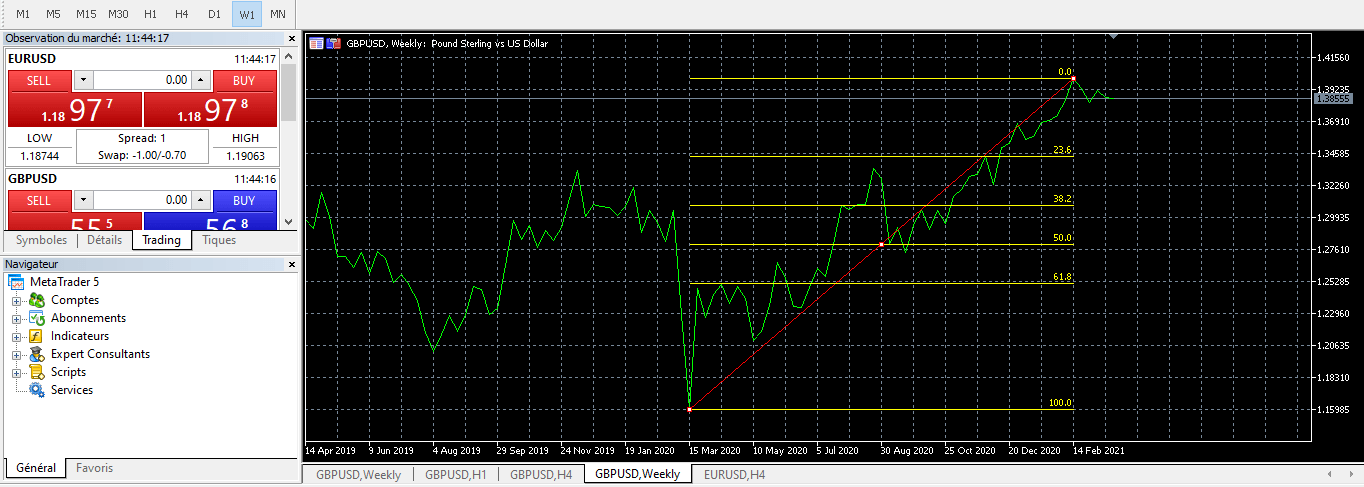
Fibonacci retracement (in red) on the GBPUSD currency pair (weekly timeframe).
- MACD: an indicator based on two lines, the signal line and the moving average line. We used it above to explain how to develop a swing trading strategy. For more details, see “Example of a Swing Trading Strategy > Analyze the Market.”
- Support and resistance: the foundation of technical analysis. Support is the point on the chart where the asset’s price starts to rise; resistance is where it starts to fall. This makes decisions easier: go long when the price bounces off support, and go short when it bounces off resistance.
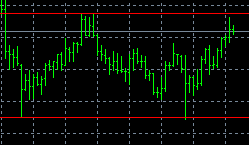
Support and resistance (red lines) on part of the GBPUSD chart (monthly timeframe).
Besides these indicators, there are also Ichimoku, Heikin Ashi, PZ and Bollinger Bands for swing trading.
Market Volatility and Swing Trading
Is market volatility an advantage in swing trading? In our view, NO. Volatility is how much an asset’s price varies. When volatility is high, you may make money, but you are even more likely to lose it. For longer-term investing, it is better to favor less volatile instruments.
The reason is simple. An asset that constantly swings up and down is clearly not ideal for swing trading. The market will not be in your favor every day, and since your positions span several days, you are bound to lose money. Too much variation can hurt your win/loss ratio.
So remember to trade low-volatility assets if you want to use this strategy. Why? Because low-volatility instruments are more predictable, as historical movements are more likely to repeat. That is why the stock market is the best market for this type of trading.
Position Size
There is no standard position size for swing trading; it depends on your needs as a swing trader. You can take large positions to maximize your chances of gain, or smaller ones. Either way, we recommend taking a substantial position size. For example, you could swing trade 50 lots (with 1,000 units per lot).
How to Choose a Broker for Swing Trading
To choose a broker for swing trading, rely on selection criteria. Studying the best brokers of 2025, we identified key features. Just make sure your chosen broker meets all these criteria to be confident of its quality. Here is what to look for:
- Regulation: the broker must hold licenses. This matters because it determines whether the broker is legal. If it is not recognized by any international regulator, do not use it for swing trading.
- Trading fees: ideally, use a broker that only charges spreads, so you pay no extra commissions, let alone swaps.
- Lot size and price: favor brokers that offer 0.1 mini lots so you can reduce your position size as much as you like.
- Real-time price streaming: this tells you whether the trend is continuing or a reversal is possible, giving you the chance to adjust your strategy or exit your positions.
- Platform quality: a good broker’s platform must support all the indicators and tools needed for technical analysis.
- Minimum investment: the amount required by the most flexible brokers ranges from €0 to €2,000, so avoid brokers that ask for too much.
- Funding methods: the broker must offer the best payment methods, as you will always need money in your account; otherwise, you won’t be able to keep your positions open for long.
- Reducing market risk: the best swing trading broker should help you cope with volatility and provide safeguards to keep you from going into a negative balance.
- Compatibility with different trading styles: above all, the broker must allow swing trading.
- Training: this helps you master the concept and become an expert in longer-term trading.
Which Broker Should You Choose for Swing Trading?
Margin Management
Margin, or leverage, is an important factor in longer-term trading, which is why we address margin management. In fact, you should not use leverage for this type of trading, or at least keep it to a minimum.
Leverage is an opportunity for gain, but it can also magnify your losses. As a swing trader, your investments are exposed to risk. When you trade with your own funds, you limit the chances of hitting rock bottom. With leverage, you still have to repay the broker’s margin even if you lose. That is why we recommend limiting your margin: it takes some of the pressure off so you can invest with peace of mind.
Tips for Success in Swing Trading
To succeed at longer-term investing, you need to follow certain guidelines. The following tips will help you become a good swing trader.
- Watch the fees: remember that you will hold your positions for several days. If a broker’s fees are too high, your longer-term profits will suffer. So choose a broker that keeps trading fees to a minimum; ideally, it should not charge swaps.
- Check the broker’s security: the longer your position, the more it is exposed to the risk of theft. That is why it is important to check the broker’s security level. It must protect your login details and personal data, and safeguard your funds with segregated accounts and compensation schemes.
- Keep a substantial balance in your account: this is crucial for holding positions over time. Even the most flexible broker will charge at least spreads, which can add up over time. If you don’t have enough to cover these costs, your positions will be closed. So fund your account properly; in short, practice good money management.
- Limit leverage: as mentioned above, leverage can also cause significant losses, especially in swing trading. Limit your margin as much as possible to avoid ending up broke.
- Have the right mindset: you need the right psychology for swing trading. First, be aware of the risk of loss with this type of trading; don’t think you will win every time. Second, be patient. Don’t be a compulsive trader: wait for the trend to really take shape before opening a position.
Swing Trading vs Other Trading Styles
Besides swing trading, which this review covers, there are three other popular types of trading:
- Scalping
- Day trading
- Hedging
These methods all differ from swing trading in their holding periods, advantages and drawbacks. In this section, we briefly compare swing trading with these other styles.
Swing Trading vs Day Trading
Day trading and swing trading techniques and strategies are different. Day trading covers a shorter period: as the name suggests, positions must be opened and closed the same day, so none of your trades last beyond the daily trading session.
You can day trade all kinds of instruments, but Forex is the best market for this style. Why? Because Forex is very volatile, so it suits short-term trading such as day trading. Unlike swing trading, intraday trading requires more involvement: you need to react quickly to seize opportunities in time.
Swing Trading vs Scalping
Compared with swing trading, scalping is a very short-term method lasting just a few minutes. If you open positions and close them 60, 20 or 10 minutes later, you are a scalper. Of course, scalping is for traders who want volatility, so Forex is the best-suited instrument. That is the exact opposite of swing trading, where stocks are the asset to look for.
Swing Trading vs Hedging
This has nothing in common with the trading styles covered so far. Hedging is a way of protecting yourself against uncertain market movements. To hedge, you open opposite positions on the same asset with the same amount.
For example, you trade a stock and have doubts about the trend. To protect yourself, you trade both up and down (two separate positions), with €2,000 on each trade. That is hedging.
This strategy can be used in both the long and short term, and there is no specific instrument on which it works best. It is therefore completely different from swing trading, where you can only follow one direction (up or down).
Profitability and Risks
Is swing trading profitable? Of course. Its annual return is estimated at 30%, meaning you can grow your capital over a few years. With a good strategy, you have a strong chance of making good profits. However, it is difficult, if not impossible, to pin down the maximum return of this trading technique; it all depends on your win/loss ratio.
This ratio is the gains made while holding your positions divided by the losses incurred over the same period. When gains exceed losses, the profitability speaks for itself; otherwise, you are making a loss.
The risk of loss is therefore inherent in this trading style. You cannot swing trade without losing money at times, because while you hold your positions, the market may move against you. For example, economic news released the previous day can upend trends and increase your risk of loss at the open. Your broker’s fees can also make your trades less profitable.
So remember that the profitability of this type of trading is real, and so are the risks of loss.
Money Management in Swing Trading
How should you manage your money when trading longer term? You need to define precisely:
- How much money you are willing to lose on each position
- How many units you should buy per position
Of course, the goal of money management is to minimize losses. So don’t take any position that could lose you more than 2% of your capital. The example below shows how to manage your funds in swing trading.
Suppose you have a trading budget of €30,000 per month. You can only afford to lose 2% of that, or €600. You find an attractive asset priced at €25 per share. Before opening a position, first decide how much you can afford to lose. To keep losses minimal, set the stop loss at €24, so you only lose €1 per share if it is hit.
Since your loss limit on this asset is €600, you can take a position on 600 shares, staying within your money management rules. You will therefore spend €15,000 to buy these 600 shares.
That is roughly how to manage your money for swing trading. Don’t forget to keep topping up your account so you always have enough to hold your positions.
Note: the example above is for illustration only. In practice, it is better to set wider stop losses to succeed with this style of investing.
Stop Loss and Take Profit
You cannot swing trade effectively without setting your limits properly. Let’s start with the stop loss. In swing trading, you can place it hundreds of pips from your entry price. Setting a wider stop loss helps avoid unexpected position closures, which are common when positions are held for a long time.
You should also set wider take profits. The good thing about this trading style is that your take profit can be further away than your stop loss, improving your risk/reward ratio.
Swing Trading Training
To master all the theory and practice of swing trading, you need training. It will help you understand the basics of this trading style and how to use indicators to develop a multi-day trading strategy.
The good news is that the best brokers offer educational programs. Vantage is by far the broker that makes it easiest to learn swing trading. It offers online courses and webinars, and a range of educational videos is available on its YouTube channel. It also offers simulations through its free demo account, so you can put all your swing trading knowledge into practice without spending a penny.
Conclusion
That is everything you need to know about this trading style. Remember that it is a longer-term way of investing, meaning you can hold your positions for longer, which requires enough money in your account. We recommend a minimum budget of €10,000 to get started. The advantage of this method is that it doesn’t require a lot of involvement, so you can get on with other things. To get started now, choose the best broker for the job. Start by testing sites such as Vantage and Axi.
Need advice on choosing the best swing trading broker? Leave us a comment and we will help you find the best swing trading platform for you!