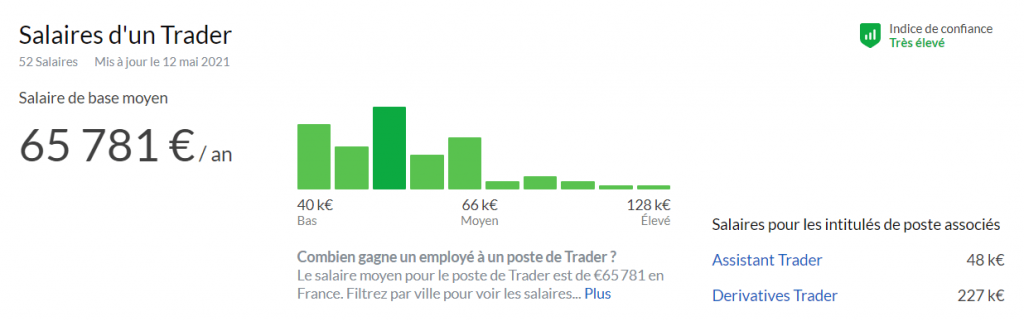
On average, a trader’s salary in France is just over €65,000 a year (base salary, excluding bonuses). This salary can exceed €200,000 a year depending on the role and the financial institution. But what about the salaries of traders abroad? And how much do independent / retail / proprietary traders earn? Let’s look at all of this in detail.
The Best Brokers to Boost Your Trading Income
You can increase your income as an independent trader by paying lower brokerage fees, which stops them from eating into your trading gains. That’s why you have a lot to gain from working with a broker that charges the lowest brokerage fees, offers a wide range of instruments (giving you more investment and profit opportunities) and provides the best trading conditions (which helps you avoid losses caused, for example, by poor order execution).
Here are the best of these brokers in the table below.
Broker | Pricing Advantages |
 |
|
 |
|
 |
|
 |
|
 |
|
If this topic interests you, also see “Trading Site” and “Free Trading Software”.
How Much Does an Independent Trader Earn?
With interest rates on bank savings products falling steadily, more and more French people are turning to the stock market, whose products can be far more profitable. But how much can you make from trading? It’s a fair question, because trading can help you get a return on your savings, top up your monthly income or even make a living if you decide to trade on your own account and know how to do it well.
An independent trader in France can earn a living from the market trades they make.
But before looking at a trader’s salary, one important point needs to be made: trading is a risky activity. Only traders who achieve profitability can earn a salary from it, and only 10% to 35% of traders manage to reach that level.
A trader’s pay therefore depends on several factors, but here we will focus on just two to estimate a trader’s monthly salary.
Retail Trader Salary Based on Capital Invested
What sets independent traders apart is that they stake their own money, so they cannot rely on a salary as guaranteed income. In the end, only performance determines a trader’s pay. This performance is measured by return on investment, or ROI: the ratio between the gains made and the capital at stake over a given period.
Generally speaking, not all independent traders are in the same boat:
- The ROI seen among most traders (average skill level) is between 15% and 25%.
- An above-average trader can achieve an ROI of 30% or even 50%.
- Elite traders can approach 100% ROI.
In practice, this ROI is applied to your capital to determine your income. With an ROI of 30% and capital of 1,000 euros, you earn 300 euros (1,000 x 30%). With an ROI of 15% and capital of 10,000 euros, you earn 1,500 euros. This shows the need to start with fairly substantial capital.
Moreover, whatever your initial funds, it’s advisable not to withdraw your first gains straight away. That way you grow your capital, and over the medium term your gains increase faster.
In France, the average income of an independent trader who spends around 5 hours a day trading is estimated at between 2,000 and 3,000 euros a month with capital of 10,000 euros.
| ★★★★★ 5/5 | Regulated by: CySEC, FSCA Year founded : | Headquarters: Limassol, Cyprus Minimum Deposit : | Trade Safely |
Proprietary Trader Salary by Type of Strategy
Regardless of skill level, a retail trader’s income is also influenced by the type of strategy used. There are two main options here:
Short-Term Strategies
These are based on speculation. The trader follows trends and tries to profit from them. With short-term strategies such as day trading or scalping, the idea is generally, after analysis, to buy an asset at the lowest price in anticipation of a rise in its value, then wait for the right moment to sell it and maximise the gain, with the holding period not exceeding one day.
Either way, short-term trading strategies are the riskiest but also the most profitable. So, how much does a day trader make? Well, a day trader’s or scalper’s income can reach 30% of the capital invested, or even more depending on experience and the time spent trading.
Medium- and Long-Term Strategies
With a long-term trading strategy, you are less interested in speculation. The focus is on building a portfolio of assets that generates relatively passive income over the medium term. Risk is lower, and so is the ROI or return.
So how much does a stock market investor or swing trader earn (swing trading can mean holding an asset for several months)? The average return with long-term strategies is around 10% of the capital invested, with the advantage that this return is generally steady each month when you invest in the right assets. The most profitable traders reach a 25% return, a figure that is hard to beat.
The Richest Retail Traders
It is quite possible to become a young millionaire trader. Even though they are only a small elite, some traders have, through their investments and discipline, become some of the wealthiest people on the planet, with incomes far beyond the salary of a Swiss banker or a Goldman Sachs trader.
Here are the fortunes of the richest individual traders:
Warren Buffett
He is the 3rd richest man in the world, with a fortune estimated at around $101 billion. Known today as the CEO of Berkshire Hathaway, he built his fortune by investing in company shares and sometimes in currencies. He is known for his great caution and wisdom, illustrated in two crises: the dot-com bubble and the subprime crisis. Warren Buffett did not invest in either of the two types of securities behind those speculative bubbles. He is considered one of the greatest investors of the 20th century.
George Soros
This Hungarian-born American billionaire is one of the most famous traders in history. Although he is better known today for his political activism, he pulled off one of the biggest trades ever made on the currency market. In 1992, he took a short position against the pound sterling and made almost $1 billion when its value collapsed.
Paul Tudor Jones
He is the 7th richest hedge fund manager in the world. Now in his sixties, he is one of the richest traders in the world with a fortune of $5.1 billion. He is an example of the determination and perseverance needed to earn a good trader’s income. He began his career at 22 as a clerk on a trading floor. In 1987, he anticipated the financial crisis and short-sold thousands of securities before “Black Thursday”.
John Paulson
John Paulson is the founder and president of the hedge fund Paulson & Co. It was during the subprime crisis that he showed his trading talent and became a billionaire. He short-sold subprime securities and pocketed more than $3.7 billion in 2007. In 2010, he earned record income for the year, with $5 billion in gains.
Can You Make a Living Trading Online on Your Own Account?
There’s no guarantee that by trading online on your own account you’ll earn anything close to the income of a Jérôme Kerviel or a Warren Buffett. But the question of whether you can make a living from it is a fair one.
Trading, thanks in part to the movies, enjoys a certain aura: people see it as a job that automatically leads to riches. But reality is very different. The income of an online home-based trader is not that of the Wolf of Wall Street, nor anywhere near the salary of a trader at a major bank.
Trading is a risky activity, but it can also be very profitable. Most people who have invested in the stock market have lost money. But hundreds of French people earn a good living as independent traders in Paris and elsewhere. To get there, there is a logical process and some prerequisites to meet.
First, you need fairly substantial capital, so that the profits it generates are high enough to be comparable to a good monthly trader’s salary.
Even with very effective strategies, your stock market gains are always proportional to the capital invested, all other things being equal. If you start with a small budget, it will take many years of reinvesting to reach a decent level of capital. On average, capital of €10,000 to €15,000 is needed to get off to a good start and have a chance of earning a high trader’s income, whatever strategy or sector you favour as a retail trader: high-frequency trading, forex trading, binary options, commodity trading, etc.
Given the risk involved in market activity, you should invest an amount you can afford to lose without being completely ruined.
You should also have savings covering your expenses for about a year before going all in on online proprietary trading. You need to put in the same hours as a salaried job to become good at it, which is why this safety net is essential.
The early days are not always easy, and you need the means to get through first weeks or months that are not always very profitable. Proprietary trading requires experience and training if you want to turn it into a career and make a living. You therefore need to learn a lot, because trading and market investing require advanced knowledge of market finance.
Finally, think carefully before getting started, and make sure you have the financial means and patience to acquire knowledge and experience.
How Much Do Bank Traders Earn?
The iconic image of the trader is someone who works at an investment bank. This type of trader is often the star of films about financial markets or on the front pages of newspapers.
Although independent traders are active in the markets, it is the traders at banks and investment firms who keep the stock market going. The financial institutions they work for hold the largest volumes of funds, so investment bank trader salaries are among the most attractive in the world of finance.
A bank trader’s pay depends on their performance, their seniority and the location of the bank that employs them. Junior trader salaries (for those new to the job) are generally between €4,000 and €6,000 a month. But a trader’s salary rises quickly: the average salary of a bank trader is 70,000 euros a year. This fixed salary is topped up with bonuses that can exceed 8 times the base salary.
Here are some trader salaries at the best-paying banks:
BNP Paribas Trader Salary
The French banking group is the 10th largest in the world. Traders there receive an average total salary of 291,000 euros a year.
Natixis Trader Salary
At this subsidiary of the BPCE group, traders earn 142,000 euros a year on average.
Barclays Trader Salary
Traders at the British investment bank Barclays are paid an average salary of 114,889 pounds sterling a year, or 133,619 euros.
Crédit Agricole Trader Salary
At Crédit Agricole, a trader earns an average total salary of 150,000 euros a year.
Cargill Trader Salary
The multinational trading company Cargill pays traders a fairly similar salary in both locations: 126,832 dollars a year in the United States (about 104,306 euros) or 110,518 CHF in Switzerland (100,748 euros).
HSBC Trader Salary
HSBC pays its traders an average of 59,506 euros a year.
 ★★★★★ 5/5 | Regulated by: CySEC, FCA, ASIC et FinCEN Year founded : | Headquarters : Limassol, Cyprus Minimum Deposit : |
Société Générale Trader Salary
Société Générale is also among the banks that pay traders best, with traders receiving an average total salary of 200,000 euros a year.
Deutsche Bank Trader Salary
Deutsche Bank pays a trader an average salary of 161,385 US dollars a year.
 Diversifiez votre patrimoineInvestissez dans l’artDes tableaux originaux, pièces uniques signées par l’artiste. Un actif tangible, loin des écrans et des cotations.Voir les tableaux →
JP Morgan Trader Salary
This investment bank is one of the best known in the world, especially since the 2008 financial crisis in which it played a key role. A junior trader at JP Morgan earns an average of 117,483 dollars.
Goldman Sachs Trader Salary
Excluding bonuses, a junior trader’s salary at Goldman Sachs can reach $700,000 a year (with annual bonuses averaging $250,000). Here, a trader can receive more than $20 million in bonuses! Traders at this bank are certainly the best paid on the planet.
UBS Trader Salary
A trader at UBS earns 110,336 dollars a year on average.
Fixed vs Variable Trader Pay
Bank traders’ pay is made up of a fixed amount and a variable amount. This structure serves as a source of motivation.
Bank Traders’ Fixed Salary
The stock market is an extremely competitive environment, and traders invest in the markets with money that isn’t theirs. Introducing a variable element creates a link between a trader’s performance and their pay.
Large banks and investment firms therefore pay their traders a fixed salary first. An investment bank trader’s fixed salary depends primarily on their seniority.
So, regardless of performance, junior traders earn lower salaries than experienced traders. A junior bank trader’s salary is between 40,000 and 50,000 euros a year.
Experienced traders earn between 60,000 and 100,000 euros a year, although some banks pay fixed annual salaries exceeding 200,000 euros.
Bank Traders’ Variable Pay
That said, what really matters for traders is the bonus, the variable part of their income. It often makes up the largest part of a trader’s pay.
To keep them motivated, traders are set profitability targets over given periods (half-yearly or yearly). Meeting these targets earns bonuses, which create differences in income based on individual performance. On average, a trader in France earns 250,000 euros in bonuses. The best traders can receive up to €1.5 million in bonuses, or even €4 to €5 million for the elite.
Caps on Traders’ Variable Pay (Bonuses) in Europe
Looking at bonus practices, traders’ bonuses in Europe are lower than in other regions such as Asia or the United States.
This is due to regulation introduced by the European Union in the aftermath of the 2008 crisis. That crisis made the public realise the negative impact of traders’ speculative activity on the real economy, even though this speculation is the source of their high incomes.
That’s why bonuses paid to investment bankers, traders and fund managers were capped.
The maximum bonus for a trader in the European Union is now capped at twice their monthly salary.
Naturally, the financial industry did not welcome this measure. In response, banks raised traders’ fixed salaries to anticipate the effects of the new rules and avoid too sharp a fall in traders’ income, the main source of motivation in the job.
How Much Do Traders Earn by Country or Exchange?
A trader’s job essentially consists of buying and selling financial securities, either on their own account or on behalf of others. The aim of this business is to make capital gains by buying at a low price and selling at a higher price (the basic way to make gains, but not the only one).
Given price fluctuations, traders must analyse and anticipate trends to optimise their gains. Financial securities are issued by economic players (banks, governments, companies, etc.) and vary between exchanges and countries.
That’s why exchanges such as New York or London are bigger and more prestigious than Paris. These differences in number, type and performance affect a trader’s activity and earnings. As a result, a trader’s salary varies depending on the country or exchange where they work:
Trader Salary in the USA
An assistant trader earns an average of 81,000 US dollars. On Wall Street, a junior trader earns an average of $93,000 a year, with bonuses of $180,000 a year. With experience, a Wall Street trader’s salary averages $130,000 a year, with $3.6 million in bonuses.
Trader Salary in Switzerland
In Switzerland, an assistant trader earns an average of 101,362 euros. A trader in Geneva or Zurich earns at least 150,000 euros per month, including bonuses.
Trader Salaries in France
In Paris, trader salaries range between 50,000 and 70,000 euros.
| ★★★★★ 5/5 | Regulated by: FCA, ASIC, CIMA Year founded : | Headquarters : Sydney, Australia
| Trade Forex |
Trader Salaries in Dubai
Excluding bonuses, an experienced trader in Dubai can earn up to $10,000 a month.
Trader Salaries in Luxembourg
Traders in Luxembourg receive an average annual base salary of 67,000 euros.
Trader Salary in Hong Kong
In Hong Kong, a trader earns an average of 86,436 euros a year, excluding bonuses.
Trader Salary in Morocco
A junior trader in Morocco earns between 9,000 and 13,000 euros, excluding bonuses.
Trader Salary in London
In general, in London, a junior trader’s salary excluding bonuses is in the range of 30,000 to 60,000 euros. They can receive more than 100,000 euros in bonuses.
Trader Salary in Belgium
A trader in Belgium earns an average of 120,000 euros a year, excluding bonuses.
Trader Salary in Canada
A trader in Montreal earns an average annual salary of 57,000 euros, excluding bonuses.
Trader Salary in Singapore
Traders in Singapore are paid an average of 106,000 euros a year.
Countries or Exchanges With the Highest Salaries
Here are the 5 exchanges where traders are best paid in the world.
Wall Street Trader Salary (United States)
It is the largest stock exchange in the world by market capitalisation and trading volume, home to the biggest banks and investment firms such as JP Morgan, BlackRock and Goldman Sachs. A Wall Street trader’s salary reaches $130,000 a year for junior traders, excluding bonuses. Even so, it averages around $99,000 a year.
London Trader Salary (United Kingdom)
The London Stock Exchange is the largest financial centre in Europe. A trader there earns around £71,000 a year on average, and a London trader’s salary can exceed £150,000 a year.
SIX Trader Salary (Switzerland)
Switzerland, this small European country, is famous worldwide for its banking industry. The average base salary of a trader in Switzerland is CHF 130,000 a year.
SGX Trader Salary (Singapore)
On average, a trader in Singapore earns a base salary of around S$120,000 a year, and this salary can exceed S$250,000 a year.
Euronext Paris Trader Salary (France)
The average base salary of a trader in France is close to €66,000 a year, and can exceed €200,000 a year.
Euronext Brussels Trader Salary (Belgium)
A trader in Belgium can earn on average just over €4,000 a month, and this Euronext trader salary can reach €10,000 a month.
Trader Salary by Level of Experience
Trading is a very dynamic profession in which experience is one of the most important assets for maximising skills and performance, and therefore a trader’s salary. This applies to traders building a career at banks as well as to professional and independent traders in general.
At the start of their career, a trader’s base salary depends on several criteria such as the country or the bank hiring them. On the trader’s side, a university degree is an asset for getting off to a good start. Holding a master’s degree from a well-known university or business school is a plus.
In France, a trader will start with a fixed salary of 4,000 euros a month on average. Over a year, junior traders earn around 50,000 euros. With experience, traders’ salaries rise.
Although there are big differences between companies and countries, an experienced trader can at least double their salary over their career compared with their starting salary.
Bonuses are linked to the trader’s performance, which generally also grows over the years: experience lets traders refine their strategies and manage ever larger sums for better profitability. In Europe, these bonuses are capped at twice the trader’s base salary.
Elsewhere, such as in the United States, they are unlimited. Experienced traders with salaries in the hundreds of thousands of dollars can receive bonuses in the millions of dollars.
How Much Do Traders Earn by Role?
In market finance, there are several profiles within the trading function. They play different roles, particularly in back and front office, with different salaries: the analyst, the assistant trader, the trader and the quant.
Financial analyst salary
Compared with the salary of a quant or trader, the analyst typically sits at the bottom of the ladder. They carry out fundamental research on securities and analyse the market, producing analytical reports on the different market segments for other market participants. In the United States, a financial analyst earns $70,500 a year on average.
Assistant trader salary
This is often a role halfway between trader and analyst. It is often the entry point into investment or market finance, and is frequently filled by interns. The assistant trader handles administrative and research work for the trader. On very busy days, they may occasionally trade basic products themselves. An assistant trader in the USA earns an average of $45,613 a year, so they are paid less than an analyst.
| ★★★★★ 5/5 | Regulated by: CySEC, FSCA Year founded : | Headquarters: Limassol, Cyprus Minimum Deposit : | Trade Safely |
Trader salary
The trader decides day to day on the buy and sell transactions that take place in the financial markets. Given the variety of players and securities, traders often specialise in particular types of trading or specific instruments. Traders receive two kinds of pay: a fixed salary that depends on the financial institution and country, plus performance bonuses. In the USA, most traders’ salaries average between $80,000 and $100,000. In France, the average trader salary is between €50,000 and €70,000.
Quant trader salary
The quant trader or quantitative analyst (“quant” being short for “quantitative”) is a trading role that emerged with new technologies. It is a more specialised profile, particularly in mathematics or applied mathematics. Quants develop predictive models for the markets (which is why they are also called algorithmic traders). They may code these models themselves or outsource the task to a developer.
Because their profiles are harder to find given their academic backgrounds (quants often hold PhDs), quant traders earn much more than traders. In the United States, a quantitative analyst’s salary can reach $250,000 a year. However, they don’t always receive bonuses as large as traders do.
How Can You Earn a Bank Trader’s Pay?
Bank traders are a privileged professional group, in a highly visible and very well-paid job. But it is possible to earn a bank trader’s pay. How? Simply by getting into independent or home-based retail trading.
Thanks to online trading, you too can start trading the financial markets from home with your own capital. By buying and selling financial securities, you generate capital gains that can add up to a significant income. Becoming an independent trader is a gateway to wealth and financial freedom.
There are two main advantages to taking up this profession:
- You control your hours. As your own boss, you work at your own pace and set your own schedule and workload.
- Your income is unlimited. If you have a good strategy, you are the sole beneficiary of the gains you make. By gradually growing your capital and mastering the markets you trade, you can reach and even exceed a bank trader’s salary.
There are plenty of examples of billionaire traders: Warren Buffett, John Paulson, George Soros and more. You may not become a billionaire, but trading on your own account is an opportunity to earn a good living.
To become an independent trader, here are the steps to follow:
- Start by defining your motivations. Psychology is crucial in trading. Being clear with yourself about your motivations is a key to success.
- Get properly trained in market finance, how the stock market works and trading tools. Successful traders are experienced, talented and have good instincts, but the foundation is solid training and a thorough command of their environment.
- Practise with demo accounts to master the tools and trading platforms.
- Choose a reliable broker, regulated by one or more leading authorities.
- Define your strategies and the market segments you will trade.
- Set your starting capital. This choice is important: your starting capital should be small enough (relative to your wealth) for you to bear the risk of loss, and large enough to trade over time and make worthwhile gains.
- Keep a trading journal to build on your experience and improve every day.
What Factors Influence Traders’ Income?
Looking at the industry, it’s clear that trader salaries are not distributed randomly. Several factors affect a trader’s level of income, including:
- The role. In trading, there are several profiles: quantitative analyst, financial analyst, assistant trader or trader. Depending on your profile, your salary will differ.
- Performance. Traders are paid a fixed salary plus bonuses. Bonuses often make up most of their pay and depend on the trader’s performance.
- The company. In every sector, some companies are bigger, more prestigious or more successful than others. The same goes for the financial institutions where traders work. This affects pay policy, and some banks pay their traders better than others.
- Location. A trader’s pay also depends on the country where they work. For example, some countries cap bonuses (EU countries), while elsewhere bonuses are paid freely (United States).
How to Increase Your Income as a Retail / Independent Trader
If you already work as an independent trader from home, you have surely realised the potential of this activity. The constant challenge is finding ways to increase your earnings.
With this in mind, a crucial step is making sure you have found and trade with the best online broker. The broker is the independent trader’s gateway to the market and influences every aspect of their activity. You should therefore:
- Find an online broker with a wide range of financial products, both in number and variety (stocks, bonds, CDS, commodities, etc.). This multiplies your investment opportunities and therefore maximises your potential gains.
- Choose an online broker with favourable spreads and commissions. These costs eat into your gains, so they should be as low as possible. An ECN or zero-spread broker is ideal for scalpers and day traders, while a low-spread broker suits less active traders and stock market investors.
- Opt for a broker that offers optimal trading conditions, particularly in terms of platforms, payment methods and execution. For example, slow, poor-quality execution can lead to your positions being opened (or closed) at prices different from those when you placed the order, potentially costing you money.
List of the Best Brokers – TOP 5 1. Libertex – Best Zero-Spread Broker + Reduced Commissions 2. eToro – Best Broker for Stocks and Beginners 3. Vantage FX – Best Forex & CFD Broker 4. AvaTrade – Best Broker for Copy Trading (after eToro) 5. Capital.com – Best Broker for Cryptocurrency Trading |
How to Calculate Your Trader Salary
If you trade on your own account, you certainly don’t receive a payslip. You can track your trades, the size of your trading account and so on. But to get a real idea of what you earn, you need to be able to work out what salary your gains correspond to.
To calculate your trader salary, here are the points to look at:
Calculating Trader Salary: ROI (Return on Investment)
This is the money you receive on top of the amount you stake in your trades (amount invested + gain). Over the medium term, your ROI depends on your strategy, how often you trade and how you use the leverage allowed by your broker. Leverage can greatly multiply your gains, but also your losses, hence the need to protect yourself with stop-loss orders, for example.
Calculating Trading Income: Capital
An independent trader has capital they use for trading, and it’s to this capital that ROI is applied. If you achieve an ROI of 12% per month with capital of 1,000 euros, you earn 120 euros that month, or 1,440 euros over the year. You therefore need fairly substantial capital to secure a decent income, even with quite profitable strategies.
Calculating Trader Salary: Costs
Trading is not free. Beyond indirect costs (electricity, internet connection, training, etc.), direct costs reduce your gains: the commissions, spreads, swaps and other fees charged by your broker. You need to deduct them from your gains before considering what you actually take home.
Calculating Trader Salary: Taxes
All income may be taxed. You must therefore make sure you comply with the tax authorities by paying the tax due for your income bracket. In short, subtract the tax you owe from your income.
Note that the calculation can also be done annually. If you don’t need or want to withdraw your gains straight away, you can leave them in your account and perhaps reinvest them to grow your capital and income.
Feel free to leave a comment to share your trader salary or anything else about your income as an independent trader or as a bank-employed trader!